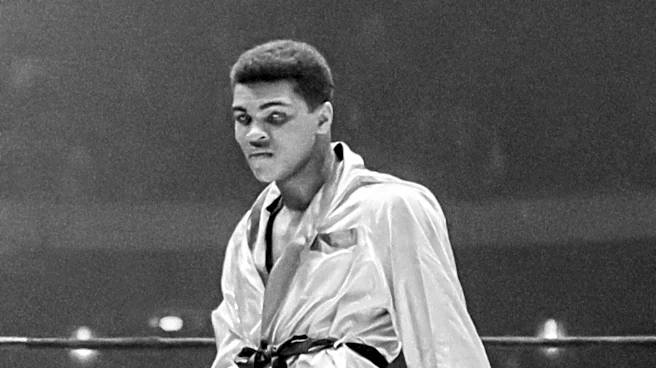







The rematch between Leon Spinks and Muhammad Ali on September 15, 1978, was more than just a fight for the WBA and The Ring heavyweight titles; it was a clash of two distinct careers at different junctures. Spinks, a relatively new professional, had achieved an astonishing upset in their first bout, while Ali, a seasoned legend, was fighting to reclaim his legacy. This second encounter, held in the Louisiana Superdome, offered a detailed look into
the physical and strategic preparations of both boxers, as well as the significant financial implications of such a high-profile event.
Tale of the Tape: A Contrast in Careers
At the time of the rematch, Leon Spinks, nicknamed "Neon," hailed from St. Louis, Missouri. He was 25 years and 2 months old, standing 6 feet 1 inch tall and weighing 201 pounds. His pre-fight professional record was an impressive 7 wins, 0 losses, and 1 draw, with 5 knockouts, showcasing a rapid ascent in the boxing world. Spinks fought with an Orthodox style and was recognized as the WBA and The Ring Heavyweight Champion, a title he had earned by defeating Ali. His purse for the rematch was a substantial $3,750,000, reflecting his status as the reigning champion.
Muhammad Ali, known as "The Greatest," came from Louisville, Kentucky. At 36 years and 7 months old, he was significantly older than Spinks. Ali stood 6 feet 3 inches tall and weighed 221 pounds. His extensive pre-fight record was 55 wins and 3 losses, with 37 knockouts, highlighting a long and illustrious career. Ali also fought with an Orthodox style and was ranked as the WBA No. 3 Heavyweight, having previously been a three-time undisputed heavyweight champion. His purse for the fight was $3,250,000, a testament to his enduring star power despite his recent loss.
The Stakes and the Strategy
The background to the rematch was complex. After his initial shock victory over Ali, Spinks was stripped of his WBC belt because he chose to fight Ali again instead of facing the WBC's number one contender, Ken Norton. This meant that only the WBA and The Ring titles were on the line in New Orleans. Ali entered the rematch as a 2½ to 1 favorite, indicating that despite his previous loss, many believed he had the experience and skill to defeat Spinks.
Ali's strategy for the second fight was a calculated response to Spinks's aggressive style. His plan was to jab, jab, throw a right, and then immediately grab Spinks. When Spinks would charge in, Ali would hook his left arm around the back of Spinks's head, pulling him into an embrace to limit his ability to punch or to throw him off balance. Ali also incorporated his famous footwork, dancing away from Spinks on the break, circling both left and right. This tactical approach was designed to control the pace and neutralize Spinks's youthful vigor, and it proved highly effective.
The Outcome and Its Aftermath
The fight proceeded largely as Ali had intended. The referee, Lucien Joubert, even penalized Ali by taking away the fifth round for excessive holding, which underscores how consistently Ali employed his clinching strategy. Despite this, Ali dominated the scoring. The Associated Press scored the fight 12–3 for Ali, while the three official judges delivered unanimous scores of 11–4, 10–4–1, and 10–4–1, all in favor of Ali. This resulted in a clear unanimous decision victory for Muhammad Ali, allowing him to reclaim the heavyweight championship.
For Leon Spinks, the loss marked a significant turning point. While his initial victory over Ali was a career highlight, the rematch demonstrated Ali's ability to adapt and overcome. For Ali, it was a triumphant return to the pinnacle of boxing, further solidifying his legendary status. The fight itself was a massive commercial success, with record-breaking attendance and viewership, cementing its place as a memorable event in boxing history.