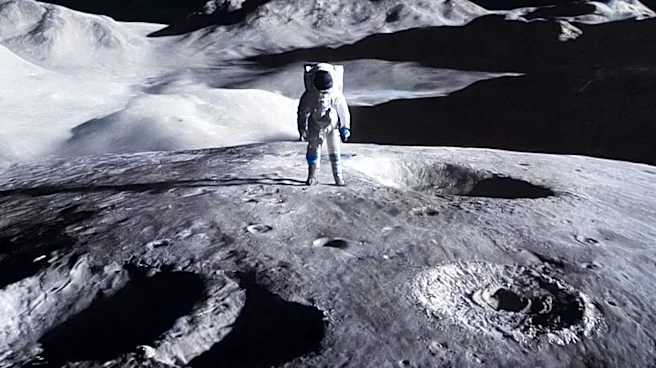


On September 12, 1962, President John F. Kennedy delivered a pivotal speech at Rice University, famously known as "We choose to go to the Moon." This address, given before an audience of nearly 40,000 people, many of whom were students, was a powerful call to action that articulated the United States' commitment to landing a man on the Moon and returning him safely to Earth before the decade was out. The speech was not merely a statement of intent
but a carefully crafted rhetorical masterpiece designed to inspire a nation and justify the immense undertaking of the Apollo program.
Kennedy's speech employed several key rhetorical strategies to achieve its goals. One significant approach was to characterize space as a new frontier, a beckoning border that offered new knowledge and new rights to be gained. This framing resonated deeply with the American pioneering spirit, suggesting that the exploration of space was a natural extension of the nation's historical journey. By presenting space exploration as an opportunity for progress for all people, Kennedy elevated the endeavor beyond a mere technological race to a universal human quest.
Rhetorical Mastery and the Call to Action
Central to the speech's impact was Kennedy's use of temporal articulation, which positioned the space effort within an urgent and logical historical moment. He condensed the entire history of humankind into fifty years, highlighting rapid advancements such as penicillin, television, and nuclear energy. This compression served to demonstrate that space travel, in a very short span, would become feasible, thereby informing his audience that their dreams of space exploration were within reach. This technique created a sense of immediacy and the perception of profound change, making the ambitious goal seem not only possible but imminent.
Another powerful rhetorical device was the repeated phrase, "We choose to go to the Moon." This phrase was uttered three times in quick succession, followed by an explanation that culminated in his declaration that the challenge of space was "one that we are willing to accept, one we are unwilling to postpone, and one we intend to win." By emphasizing the element of choice, Kennedy underscored the American people's agency in pursuing this monumental task. He did not present it as a necessity but rather as a deliberate decision, highlighting the benefits of national unity and competitive spirit that such an endeavor could foster.
Inspiring a Nation: Beyond the Technical Challenge
Kennedy's speech at Rice University painted a romantic vision of space exploration, one in which all Americans, and indeed the entire world, could participate. He began by describing space as a new frontier for all humanity, igniting a sense of wonder and aspiration among his listeners. This inclusive language significantly broadened the appeal of space exploration, drawing in a wider segment of the citizenry.
Furthermore, Kennedy's use of the first-person plural "we" throughout the speech was crucial. While it represented all people globally who might explore space together, it also specifically included the audience at Rice University, making them feel directly involved in this grand undertaking. This collective pronoun reinforced the idea that the lunar mission was a shared national endeavor, a testament to American freedom and determination. The speech's enduring legacy lies in its ability to transform a daunting technical challenge into a compelling national purpose, inspiring generations to look skyward with ambition and hope.