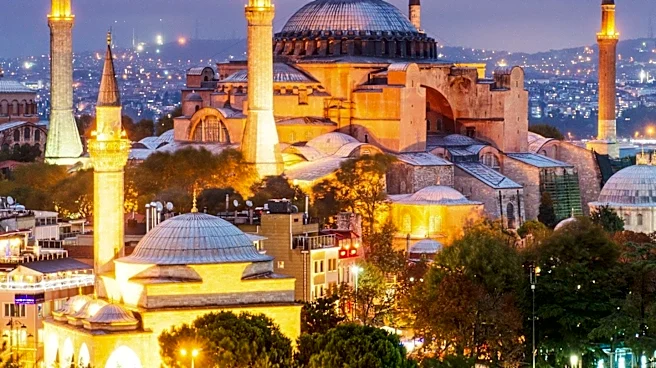

Hagia Sophia, officially known as the Hagia Sophia Grand Mosque, stands as a prominent cultural and historical landmark in Constantinople, now Istanbul, Turkey. This iconic structure has undergone numerous
transformations throughout its long history, serving as a church, a museum, and most recently, a mosque. Completed in AD 537, it was the last of three church buildings erected on the site by the Eastern Roman Empire. Its construction marked a pivotal moment in architectural history, introducing groundbreaking techniques and establishing itself as a masterpiece of Byzantine design. Its journey reflects centuries of changing empires and religious dominance in the region.
Architectural Grandeur and Innovation
Upon its completion in AD 537, the Hagia Sophia achieved the distinction of being the world's largest interior space. This monumental achievement was largely due to its innovative use of a fully pendentive dome, a structural element that revolutionized architectural possibilities. This design allowed for a vast, open interior, creating a sense of awe and grandeur that was unprecedented for its time. The building is widely regarded as the epitome of Byzantine architecture, a style characterized by its intricate mosaics, grand domes, and rich ornamentation.Architectural historians often credit the Hagia Sophia with having "changed the history of architecture." Its sophisticated engineering and aesthetic principles influenced countless subsequent religious buildings and public structures across the Byzantine Empire and beyond. The sheer scale and complexity of its construction demonstrated an advanced understanding of structural mechanics and artistic vision, setting new standards for monumental building projects.
A History of Religious and Political Transitions
From its dedication in 360 AD until 1453, the Hagia Sophia functioned as the cathedral of Constantinople, adhering to the Byzantine liturgical tradition. This period, however, was interrupted between 1204 and 1261 when Latin Crusaders occupied the city and installed their own religious hierarchy within the cathedral. This temporary shift in control highlights the turbulent political landscape of the era and the strategic importance of the Hagia Sophia.Following the Ottoman conquest of Constantinople in 1453, the Hagia Sophia was converted into a mosque. This conversion marked a significant change in its religious identity and architectural use, with Islamic elements being integrated into its existing Byzantine framework. For centuries, it served as a central mosque, reflecting the new dominant culture and faith of the city.
Modern Eras: Museum and Reconversion
In 1935, the Hagia Sophia underwent another major transformation, being converted into a museum. This decision aimed to present the building as a secular monument, allowing visitors from all backgrounds to appreciate its historical and architectural significance without religious affiliation. As a museum, it became a symbol of cultural heritage and a bridge between different historical periods and traditions.However, this status was not permanent. In 2020, the Hagia Sophia was once again converted back into a mosque. This reconversion reignited discussions about its identity and purpose, underscoring its enduring role as a site of profound historical, cultural, and religious importance. Its continuous evolution from church to mosque, then museum, and back to mosque, makes it a unique testament to the shifting tides of history in Istanbul.