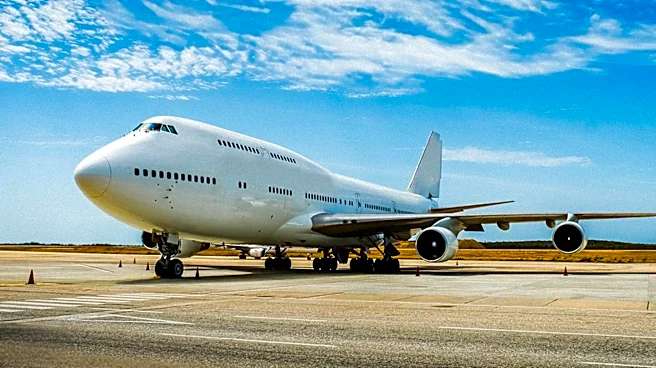








The Boeing 747, a groundbreaking wide-body jetliner, underwent continuous evolution throughout its production history, adapting to changing airline demands and technological advancements. From its initial rollout in 1969 to the sophisticated -400 series, each variant introduced improvements in capacity, range, and operational efficiency. This iterative development process, while sometimes criticized for its incremental nature, allowed the 747 to maintain
its status as a leading aircraft in the very large passenger jet market for decades.
Early Iterations and Capacity Enhancements
Following the introduction of the original 747-100, Boeing quickly began developing improved versions. The -100B variant offered a higher maximum takeoff weight (MTOW), allowing for greater fuel capacity and extended range. The -100SR (Short Range) was designed with a higher passenger capacity, catering to markets with dense, shorter-haul routes. In 1971, the 747-200 model was introduced, featuring more powerful engines and an even higher MTOW. This versatility led to the production of passenger, freighter, and combination passenger-freighter versions of the -200, demonstrating the aircraft's adaptability.
A significant development in the 747 line was the shortened 747SP (special performance), which entered service in 1976, offering a longer range. Throughout the 1970s, Boeing primarily focused on enhancing the payload capabilities of the 747-200 and its subvariants. Weight trials in 1970 saw the prototype 747-200B achieve a maximum takeoff weight of 820,700 pounds, setting a record at the time. Later, in 1976, an RB211-powered 747-200 set another world record by lifting 840,500 pounds during a trial flight. These early improvements laid the groundwork for future, more substantial upgrades.
The Stretched Upper Deck and Customer Feedback
Further development led to the launch of the 747-300 on June 11, 1980, with interest from Swissair a month later. The primary innovation of the -300 series was its stretched upper deck (SUD), which significantly increased seating capacity. This modification was a result of Boeing's studies to boost passenger numbers, rejecting ideas like fuselage plugs or extending the upper deck over the entire length of the fuselage. The first 747-300, completed in 1983, also boasted increased cruise speed. The variant was initially designated 747SUD, then 747-200 SUD, and later 747EUD, before finally settling on the 747-300 designation. Like its predecessors, the 300 series was produced in passenger, short-range, and combination freighter-passenger versions.
However, throughout the early 1980s, Boeing faced criticism from customers who felt the company's approach to 747 development was too incremental. Airlines pointed out that previous variants were largely derivatives of the original 747-100, with improvements focused on single aspects like payload, range, or passenger capacity, rather than comprehensive redesigns incorporating newer technologies. Lufthansa's deputy chairman, Reinhardt Abraham, voiced these concerns publicly in 1984, stating that a "piecemeal approach" increased development costs for airlines and led to fleets with little commonality between variants. He advocated for "one full package" of improvements as a significant incentive for new orders.
The Advanced 747-400: A Response to Modern Demands
Responding to the growing demand for a modernized 747, Boeing launched the development of the longer-range 747-400 in October 1985. This variant represented a more substantial upgrade, incorporating several key advancements. It featured a new glass cockpit, which reduced the required cockpit crew from three to two, a significant operational cost saving for airlines. The -400 also utilized new engines, lighter construction materials, a redesigned interior, increased fuel capacity, and aerodynamic improvements such as a longer wingspan and added winglets. These enhancements allowed the -400 to fly farther and faster than its predecessors.
The development of the 747-400 was not without its own challenges. Development costs soared, and production delays occurred as new technologies were integrated at the request of airlines. Insufficient workforce experience and reliance on overtime contributed to early production problems. Despite these hurdles, the -400 entered service in 1989. The 747-400 also saw further specialized variants, including the -400F (freighter), -400M (combi), and -400D (domestic for the Japanese market). The extended range versions, -400ER and -400ERF, entered service in 2002, further pushing the boundaries of the 747's capabilities. The 747-400 remained the most-delivered 747 variant, with 694 units delivered over 20 years, until production of the passenger version officially ceased in 2007, marking a significant chapter in the aircraft's storied history.