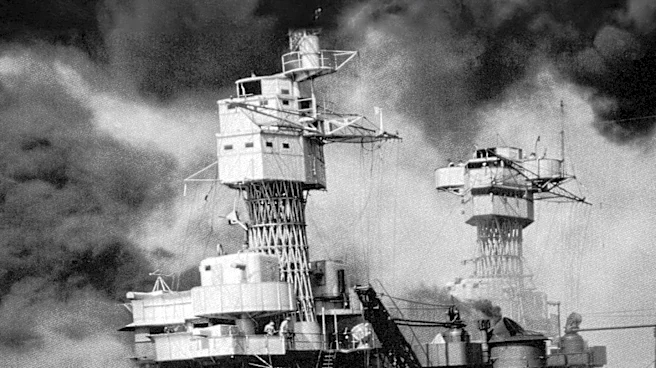


The Naval Battle of Guadalcanal, specifically the engagement on the early morning of November 13, 1942, was a maelstrom of close-quarters combat, confusion, and unexpected turns. Fought in the near-complete darkness of Ironbottom Sound, this battle saw American and Japanese forces intermingle in a desperate struggle. The lack of clear communication, the unexpected proximity of the enemy, and the sheer intensity of the fighting created a "barroom brawl
after the lights had been shot out" atmosphere, as one officer described it.
A Confused Approach and Initial Hesitation
As the Japanese force approached Guadalcanal, a large and intense rain squall, combined with a complex formation and confusing orders from Admiral Abe, split their formation into several groups. Meanwhile, the U.S. force steamed in a single column in Ironbottom Sound, with destroyers leading and trailing the cruisers in the center. Despite five U.S. ships possessing the new, superior SG radar, none were placed in the forward part of the column, nor was one chosen as the flagship by Admiral Callaghan, who also failed to issue a battle plan to his ship commanders.
U.S. reconnaissance aircraft had spotted the approaching Japanese ships, warning Allied command. This allowed Admiral Turner to detach all usable combat ships to protect troops ashore and order supply ships at Guadalcanal to depart. Admiral Callaghan, being senior to the more experienced Admiral Scott, was placed in overall command. The Japanese warship force, under Abe, assembled north of Indispensable Strait and proceeded towards Guadalcanal, aiming for an early morning arrival on November 13. A convoy of slower transport ships and 12 escorting destroyers, commanded by Raizō Tanaka, began its run down The Slot, expected to arrive during the night of November 13.
The Battle Erupts: Akatsuki and Atlanta Bear the Brunt
At approximately 01:25 on November 13, in near-complete darkness, the Imperial Japanese force entered the sound between Savo Island and Guadalcanal, intending to bombard Henderson Field. They arrived from an unexpected direction, entering from the west side of Savo Island rather than the north. Unlike their American counterparts, Japanese sailors had extensively drilled and practiced night fighting, conducting frequent live-fire gunnery exercises, which proved advantageous. Several U.S. ships detected the Japanese on radar around 01:24, but communication issues, lack of discipline, and inexperience hindered the relay of this crucial information to Admiral Callaghan. His limited understanding of the new radar technology further delayed action, as he tried to reconcile radar reports with his visual sight picture.
Minutes after initial radar contact, both forces sighted each other almost simultaneously, but both Abe and Callaghan hesitated. Abe was surprised by the proximity of the U.S. ships and, with his battleships loaded with special bombardment ammunition rather than armor-piercing shells, was momentarily uncertain whether to withdraw or continue. He decided to press on. Callaghan, confused by incomplete information and the scattered Japanese formation, issued several confusing orders and delayed too long. The U.S. formation began to break apart, further delaying Callaghan's order to fire as he tried to ascertain and align his ships. As the formations overlapped, individual ship commanders on both sides anxiously awaited permission to open fire.
Intermingled Chaos and Devastating Blows
At 01:48, the destroyers Akatsuki and Hiei turned on large searchlights, illuminating the USS Atlanta only 3,000 yards away. Both sides spontaneously began firing, and the formations quickly disintegrated. Realizing his force was almost surrounded, Callaghan issued the confusing order, "Odd ships fire to starboard, even ships fire to port," despite no pre-battle planning for such identities and the ships no longer being in coherent formation. Most U.S. ships opened fire, many having to quickly change targets to comply. The battle became a chaotic, short-range melee where superior Japanese optics and night battle drills proved deadly. The lead American destroyer, USS Cushing, almost collided with Japanese destroyers Yūdachi and Harusame, with both sides turning to avoid each other. An officer on the USS Monssen described it as a "barroom brawl after the lights had been shot out."
At least six U.S. ships, including Laffey, O'Bannon, Atlanta, San Francisco, Portland, and Helena, fired at Akatsuki, which had drawn attention with its searchlight. Akatsuki responded with 5-inch shell hits that disabled Atlanta's torpedo tubes. However, Akatsuki sustained far more damage, with heavy caliber shells destroying its starboard engine room and setting it on fire. Another wave of hits blasted the port engine room and crippled its steering, causing Akatsuki to list and sink at 1:55, with only 18 survivors. Atlanta, as the lead U.S. cruiser, was immediately targeted by Hiei, taking up to 13 6-inch hits that set her on fire and disabled her aft guns. Ikazuchi and Inazuma also fired torpedoes, with one from Ikazuchi exploding and cutting all power to Atlanta's engineering spaces. The disabled Atlanta then drifted into the line of fire of the USS San Francisco, which accidentally hit her with nineteen 8-inch shells, killing Rear Admiral Norman Scott and most of the ship's command staff. Without power, Atlanta drifted out of the battle, leading to her eventual scuttling.
Hiei Under Fire and San Francisco's Ordeal
The USS Cushing, after its near collision, fired at the Amatsukaze but failed to inflict damage. Cushing was then ambushed by Nagara, Yukikaze, and Harusame, who mistook her for an enemy cruiser and opened fire at 3,000 yards. Cushing's power lines were cut, and her electrical and engine power disabled, leaving her defenseless. Blasted by over 20 shell hits and engulfed in fire, Cushing could only respond with machine gunfire, causing minor damage to Yukikaze. As Cushing drifted, her crew watched the massive Hiei sail past. Meanwhile, Ikazuchi, after helping sink Atlanta, was hit by two or three 8-inch shells from San Francisco, starting a fire and disabling her forward turret.
Hiei, with its nine searchlights illuminated, its immense size, and its course directly through the U.S. formation, became the focus of many U.S. ships. Portland scored several hits with its main guns, while destroyers Aaron Ward, Barton, Monssen, and Fletcher closed in. The USS O'Bannon was the first destroyer to attack Hiei, hitting her with 5-inch shells and two torpedoes that failed to explode. The USS Laffey, after evading the burning Cushing, encountered Hiei so closely that they narrowly avoided a collision. Laffey raked the Japanese battleship with 5-inch shells and machine-gun fire, causing heavy damage to the superstructure and bridge, wounding Admiral Abe and killing his chief of staff. Abe's ability to direct his ships was severely limited for the rest of the battle. The USS Sterett also hit Hiei multiple times, contributing to the fires. Unable to depress her main or secondary batteries low enough to hit the destroyers, Hiei concentrated on the USS San Francisco, which was passing by only 2,500 yards away. Along with Kirishima, Inazuma, and Ikazuchi, Hiei made repeated hits on San Francisco, disabling her steering control and killing Admiral Callaghan, Captain Cassin Young, and most of the bridge staff. The initial salvos from Hiei and Kirishima were fragmentation shells, which caused less internal damage than armor-piercing shells would have, potentially saving San Francisco from immediate sinking. It took the Japanese battleships several minutes to switch to armor-piercing ammunition, allowing San Francisco to momentarily escape the melee. In return, San Francisco hit Hiei with at least seventeen 8-inch shells, one or two of which flooded Hiei's steering gear room, shorting out her power steering and severely inhibiting her steering capability. The USS Helena followed San Francisco, taking five 6-inch hits from Kirishima, which caused minor damage and killed one sailor.