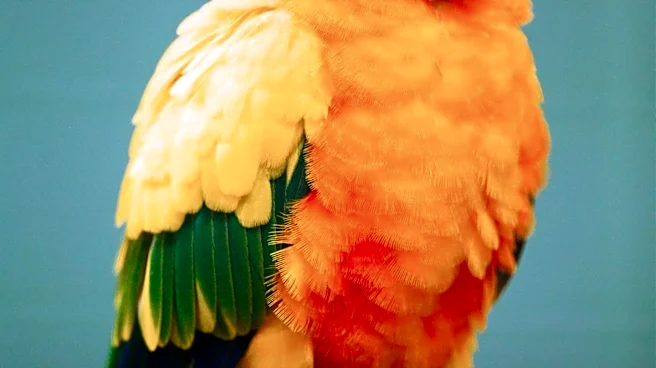








The sun conure, also known as the sun parakeet, is a strikingly colorful, medium-sized parrot native to northeastern South America. This species, scientifically classified as *Aratinga solstitialis*, is renowned for its predominantly golden-yellow plumage, which is often flushed with orange on its underparts and face. Its wings and tail are tipped with vibrant green and blue, creating a truly eye-catching display. While both male and female adults
share a similar appearance, females may be slightly lighter and more slender, with a shorter tail, a smaller, rounder head, and a smaller beak. These social birds typically live in large flocks and form monogamous pairs for reproduction, nesting in palm cavities within tropical regions.
Physical Characteristics and Identification
Adult sun conures typically weigh around 4 ounces (110 grams) and measure about 12 inches (30 centimeters) in length. Their rich yellow crown, nape, mantle, and chest are complemented by orange and red around the ears and on the belly. The base of their greater wing coverts, tertials, and the base of their primaries are green, while the secondaries, tips of the primaries, and most primary coverts are dark blue. Their tail is olive-green with a blue tip, and their bill is black. The legs and bare eye ring are grey, though the eye ring often fades to white in captivity, which can make it difficult to determine an individual's "purity" based on this feature.
Sun conures can be easily confused with closely related species such as the jandaya parakeet and the sulphur-breasted parakeet. However, the jandaya parakeet has entirely green wing coverts, mantle, and vent, while the sulphur-breasted parakeet exhibits green mottling on its mantle and less orange on its underparts. Juvenile sun conures present a predominantly green plumage, resembling young sulphur-breasted parakeets. The distinctive yellow, orange, and reddish coloration on their back, abdomen, and head develops as they mature, transforming them into the brilliant birds they are known to be.
Social Behavior and Habitat
Like other members of the *Aratinga* genus, sun conures are highly social creatures, typically found in large flocks ranging from 15 to 30 individuals. They rarely separate from their flock, and if they do, they emit loud, high-pitched squawks and screams that can travel for hundreds of yards, enabling them to communicate and reunite with their group. While feeding, flocks are relatively quiet, but they become very vocal and noisy when in flight. These birds are fast, direct flyers and can cover many miles in a single day. Beyond vocalizations, they also engage in nonverbal communication through various physical displays.
Throughout the daylight hours, birds within a flock rest, feed one another, preen, and bathe. They navigate through trees using their beaks for additional support and possess the ability to use their feet like hands to hold, examine, or eat items. Sun conures are known to nest and roost in tree cavities. During molting, they can become irritable due to discomfort, but bathing, warm rainfalls, and humidity help the sheaths of their pin feathers open more easily, alleviating their discomfort. These parrots are also described as extremely smart and curious, requiring constant mental stimulation and social interaction, especially in captivity. While their speech and ability to learn tricks in captivity are moderate, relatively little is known about their specific behavior in the wild, partly due to past confusion with the sulphur-breasted parakeet, though their behaviors are unlikely to differ significantly.
Diet and Reproduction in the Wild
In their natural habitat, sun conures primarily feed on a diverse diet of fruits, flowers, berries, blossoms, seeds, nuts, and insects. They consume both ripe and half-ripe seeds from fruits and berries, and their diet also includes red cactus fruit, Malpighia berries, and legume pods. Flocks near Karasabai have been observed feeding on monkey brush plants, where their colorful plumage provides camouflage against the red and yellow flowers as they eat. Occasionally, they may forage from agricultural crops, sometimes being considered pests. Their dietary needs change with life stages, requiring more protein during breeding season, more carbohydrates when rearing young, and increased calcium during egg production.
Young sun conures typically form monogamous pairs around 4 to 5 months of age. Before breeding, they may be seen feeding and grooming each other. Mating can last up to three minutes, after which pairs become very affectionate. The female's abdomen noticeably swells before egg-laying. They are known to nest in trees or in the cavities of Mauritia flexuosa palms. Active nests have been observed to contain multiple adults, as well as eggs and young birds of various ages, suggesting the possibility of cooperative breeding, with eggs and chicks present from January to October. The fertility rate of sun conures is relatively high, with a typical clutch size of three or four white eggs laid at two- to three-day intervals. Females are solely responsible for the 23 to 27-day incubation period, leaving the nest only for short feeding periods, while males aggressively protect the nest from predators. Chicks are born blind, naked, and vulnerable, opening their eyes and developing feather quills after about 10 days. Both parents participate in feeding the chicks, which remain dependent for 7 to 8 weeks after hatching, becoming independent after 9 to 10 weeks. Sun conures reach sexual maturity around 2 years of age and can live for 25 to 30 years.
Conservation Status and Threats
The sun conure is currently classified as Endangered on the IUCN Red List. Its population has declined rapidly due to excessive capture for the pet trade. It is estimated that over 20,000 individuals were exported for the pet trade to Singapore alone between 2005 and 2006. As of 2021, the total remaining wild population is estimated to be less than 2,500 individuals, meaning more sun conures now live in human homes than in the wild. While countries like the United States, Australia, and the European Union banned the import of wild birds in 1992, 1995, and 2005, respectively, leading to captive-breeding largely replacing the demand for wild-caught individuals in these regions, the international parrot trade remains a lucrative industry. The species has seen a decline of 50-79% across its range in the Roraima state of Brazil over the past two decades. However, its small remaining population in Guyana is showing signs of recovery due to intense conservation efforts. Despite being regularly bred in captivity, the poaching of wild individuals continues to pose a serious threat to this magnificent bird.