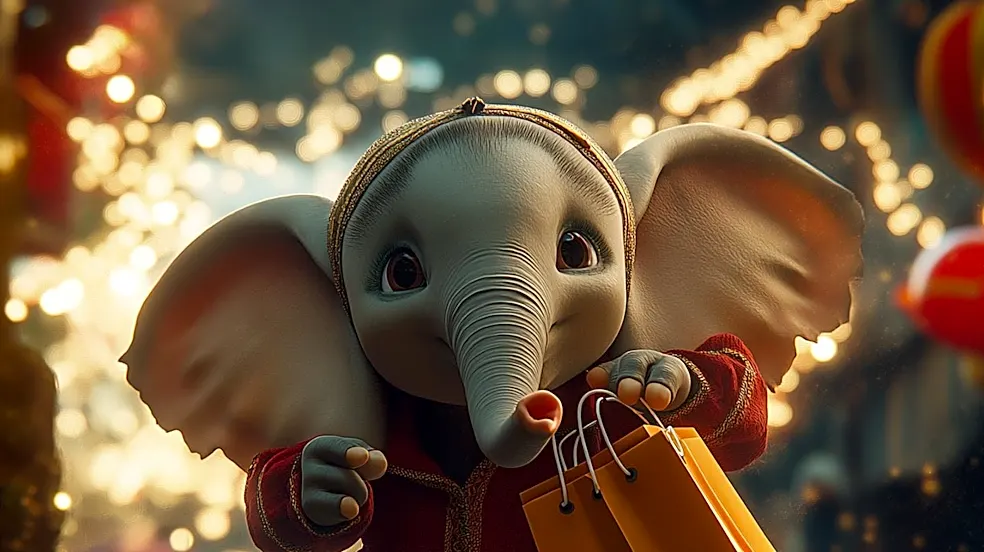

"Dumbo," the 1941 American animated musical fantasy film produced by Walt Disney Productions and released by RKO Radio Pictures, holds a significant place in animation history. It was conceived as a deliberate
pursuit of simplicity and economy, aiming to recoup financial losses incurred by previous Disney features like "Pinocchio" and "Fantasia." This focus on efficiency resulted in one of the studio's shortest animated features, clocking in at just 64 minutes. The film's origins trace back to a children's story written by Helen Aberson-Mayer and Harold Pearl, with illustrations by Helen Durney, which was initially part of a novelty toy called a "Roll-a-Book." Walt Disney himself recognized the story's potential and heartwarming appeal in late 1939, leading him to purchase the rights.
Production and Financial Strategy
The production of "Dumbo" was notably different from its predecessors. Unlike the lavish detail seen in "Fantasia," "Pinocchio," and "Snow White and the Seven Dwarfs," "Dumbo" featured simpler character designs, less detailed backgrounds, and a greater use of frames in character animation. This streamlined approach was a direct response to the studio's financial situation, which had been negatively impacted by the war in Europe. The simplicity, however, proved to be a creative advantage, freeing animators from excessive concern over detail and allowing them to concentrate on character performance, which is considered a major achievement in traditional American animation.
Despite its modest budget of $813,000, which was less than a third of "Pinocchio's" cost and half of "Snow White's," "Dumbo" proved to be a financial success. It grossed $1.6 million in its initial release, a significant return on investment, especially considering its release shortly before the United States entered World War II. The film was even slated to be on the cover of Time magazine's December 1941 issue, though this plan was abandoned after the attack on Pearl Harbor.
Critical Acclaim and Lasting Impact
Upon its release on October 23, 1941, "Dumbo" was met with critical acclaim for its story, humor, visuals, and music. It received an Academy Award for Best Scoring of a Musical Picture, with its musical directors Frank Churchill and Oliver Wallace being recognized. Churchill and lyricist Ned Washington also received an Oscar nomination for Best Song for "Baby Mine," a poignant lullaby featured in the film. The film's artistic merit was further acknowledged when it won Best Animation at the Cannes Film Festival in 1947.
Beyond its initial success, "Dumbo" has maintained its popularity over the decades. It has been re-released in theaters multiple times, including in 1949, 1959, 1972, and 1976. It was also one of the first Disney animated films to be broadcast on television as part of Disney's anthology series and was the first Disney film released on video in 1981. Its enduring appeal led to the creation of a popular theme park attraction, merchandise, a television series, and a live-action adaptation in 2019. In 2017, the film was selected for preservation in the United States National Film Registry by the Library of Congress, recognized for being "culturally, historically and aesthetically significant."
Controversies and Character Portrayals
While widely celebrated, "Dumbo" has also faced criticism, particularly regarding the stereotyping of Black people through the portrayal of the crows. The voices for the crows were provided by African American actors, specifically members of the Hall Johnson Choir. Some critics have pointed to a "racist" attitude in these portrayals. However, other analysts argue that the crows are depicted as sympathetic to Dumbo's plight, free-spirited, and intelligent, offering a contrast to common stereotypes of the time. Their song, "When I See an Elephant Fly," is noted for its complex wordplay, primarily mocking Timothy rather than Dumbo. This nuanced perspective highlights the ongoing discussion surrounding the film's cultural representations.