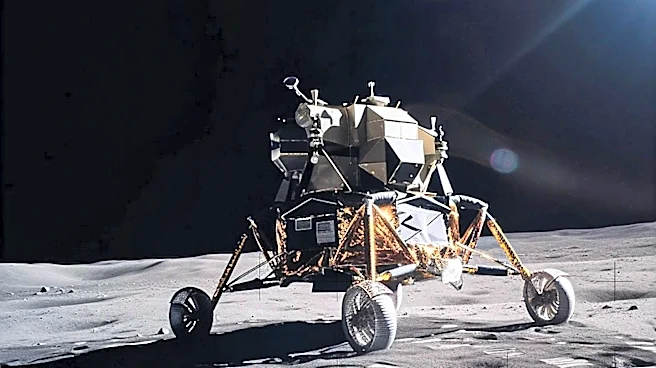



Apollo 15 was a landmark mission in the Apollo program, not only for its successful Moon landing but also for its significant scientific contributions. As the first of the J missions, Apollo 15 placed a greater emphasis on scientific exploration, utilizing advanced equipment and techniques to expand our understanding of the Moon.
The Lunar Roving Vehicle and Surface Exploration
One of the most notable advancements of Apollo 15 was the introduction of the Lunar Roving Vehicle (LRV). This electric
vehicle allowed astronauts David Scott and James Irwin to travel further from the Lunar Module than ever before, covering more ground and conducting a wider range of scientific experiments. The LRV enabled the collection of 170 pounds of lunar material, including the Genesis Rock, which provided insights into the Moon's early crust.
The extended stay on the lunar surface, totaling 18.5 hours over four extravehicular activities, allowed for comprehensive geological studies. The astronauts conducted experiments to measure the Moon's magnetic field and seismic activity, contributing valuable data to our understanding of lunar geology.
Orbital Experiments and Deep Space Exploration
While Scott and Irwin explored the lunar surface, Command Module Pilot Alfred Worden conducted a series of experiments from lunar orbit. The scientific instrument module (SIM) bay of the service module housed a suite of instruments, including a panoramic camera, gamma-ray spectrometer, and mass spectrometer. These tools collected data on the Moon's composition and environment, enhancing our knowledge of its geological history.
Worden's work in orbit also included the deployment of a lunar subsatellite, which continued to gather data on the Moon's gravitational field and magnetic environment long after the mission concluded. This comprehensive approach to lunar exploration set a new standard for scientific inquiry in space.
Legacy and Impact on Future Missions
Apollo 15's scientific achievements had a lasting impact on the field of lunar exploration. The mission's success demonstrated the value of extended stays on the Moon and the use of advanced equipment like the LRV. The data collected during Apollo 15 informed subsequent missions, guiding site selection and experiment design.
The mission also highlighted the importance of training astronauts in geology and other scientific disciplines, ensuring they could effectively conduct experiments and make observations. This emphasis on science paved the way for future missions, including Apollo 17, which continued to build on the foundation laid by Apollo 15.
In summary, Apollo 15 was a pivotal mission that advanced our understanding of the Moon and set new standards for scientific exploration in space. Its legacy continues to influence lunar research and inspire future generations of scientists and explorers.