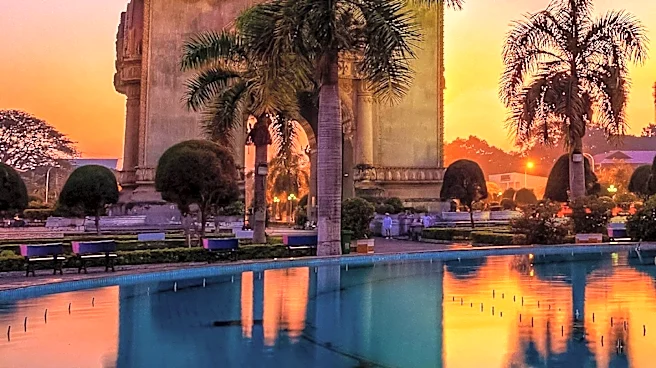






Vientiane, the capital and largest city of Laos, has a rich history that reflects the broader historical currents of Southeast Asia. Situated on the banks of the Mekong River, Vientiane has been a focal point of cultural and political change over the centuries. From its early days as a Khmer settlement to its role as the capital of the Lan Xang kingdom, and later as a French colonial administrative center, Vientiane's history is a tapestry of influences
and transformations.
Early Beginnings and Khmer Influence
The origins of Vientiane can be traced back to its days as a Khmer settlement. It was centered around a Hindu temple, which was later replaced by the Pha That Luang, a significant Buddhist stupa. This early period laid the groundwork for Vientiane's cultural and religious landscape, which would continue to evolve over the centuries. The Khmer influence is a testament to the city's early importance in the region, serving as a hub for trade and cultural exchange.
In the 11th and 12th centuries, the Lao and Thai people began to migrate into Southeast Asia from southern China. This migration led to significant demographic changes in the region, with the remaining Khmer population either assimilating into the emerging Lao civilization or being displaced. This period marked the beginning of Vientiane's transformation into a predominantly Lao city, setting the stage for its future as a major center of power.
The Rise of Lan Xang and Vientiane's Capital Status
In 1354, the kingdom of Lan Xang was founded by Fa Ngum, and Vientiane became an important administrative city. However, it was not until 1563 that King Setthathirath officially established Vientiane as the capital of Lan Xang. This decision was made to protect the kingdom from Burmese invasions, highlighting Vientiane's strategic importance.
As the capital, Vientiane became a center of Buddhist teachings and temple construction, further solidifying its cultural significance. The city's status as the capital of Lan Xang continued until the kingdom's dissolution in 1707, after which Vientiane became an independent kingdom. This period of independence was short-lived, as the city was conquered by Siam in 1779 and made a vassal state.
Colonial and Modern Transformations
The 19th century brought significant changes to Vientiane with the arrival of the French. In 1893, Vientiane came under French control and became the capital of the French protectorate of Laos in 1899. The French rebuilt the city, introducing colonial architecture and infrastructure, while also restoring important Buddhist temples.
During World War II, Vientiane was occupied by Japanese forces, but it was liberated by French paratroopers in 1945. The post-war period saw further political upheaval, culminating in the establishment of the Lao People's Democratic Republic in 1975. Vientiane was confirmed as the capital, marking the beginning of a new era in its long and storied history.