


Disney's 2010 animated feature, *Tangled*, stands out not only as a beloved musical fantasy but also as a significant milestone in animation history due to its innovative artistic and technological approach. The film, which took six years to produce and cost an estimated $260 million, aimed to bridge the gap between classic hand-drawn animation and modern computer-generated imagery (CGI). This ambitious goal led to the development of unique techniques
that allowed *Tangled* to achieve a visual style reminiscent of oil paintings while leveraging the capabilities of 3D computer graphics. The creative team sought to make the computer a tool for the artist, rather than letting technology dictate the aesthetic, resulting in a film that felt both familiar and groundbreaking.
A Vision of "Three-Dimensional Drawing"
Initially, Disney animator Glen Keane, who conceived and proposed *Tangled* in 2001, envisioned the film being animated using a traditional 2D animation process. However, Disney executives David Stainton and Dick Cook stipulated that production would only be approved if the film utilized 3D computer graphics. This directive prompted Keane to organize a seminar titled "The Best of Both Worlds," where he collaborated with 50 Disney CGI and traditional artists to explore the advantages and disadvantages of each animation style. The outcome was a decision to proceed with 3D CGI animation, but with a crucial caveat: it had to extend the traditional 2D Disney aesthetic. This meant adhering to the naturalistic animation principles documented by Frank Thomas and Ollie Johnston in *The Illusion of Life: Disney Animation*, ensuring the film retained the classic Disney feel despite its modern medium.
Keane's vision was to create a "three-dimensional drawing," where the artist maintained control over the technology. He repeatedly emphasized his desire to make the computer "bend its knee to the artist," rather than the other way around. This philosophy drove the development of numerous new techniques and tools, as many of the capabilities Keane demanded did not exist when the project began. The Walt Disney Animation Studios had to invent these solutions internally. Keane expressed his goal clearly, stating, "There's no photoreal hair. I want luscious hair, and we are inventing new ways of doing that. I want to bring the warmth and intuitive feel of hand-drawn to CGI."
Crafting a Painterly Aesthetic
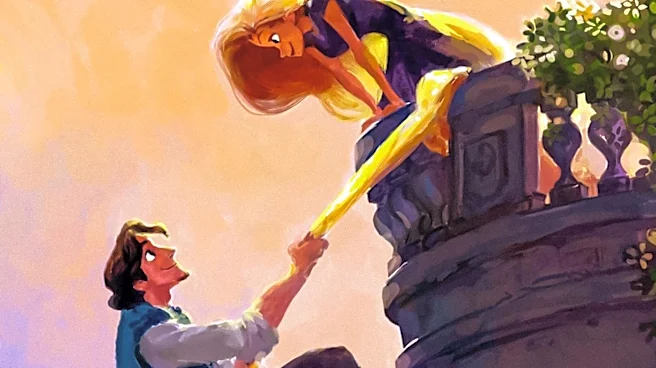
The visual style of *Tangled* was heavily influenced by the Rococo paintings of French artist Jean-Honoré Fragonard, particularly his work *The Swing*. These paintings served as key references for the film's artistic direction, which Keane described as "romantic and lush." To achieve the impression of a painting, the production employed non-photorealistic rendering. This technique allowed the CGI to mimic the textures and qualities of traditional art, moving away from a purely photorealistic approach.
One of the primary objectives for the animators was to replicate the soft, fluid movement characteristic of hand-drawn art found in older Disney animated films. Glen Keane credited Disney 3D animator Kyle Strawitz with playing a pivotal role in merging CGI with the traditional hand-drawn style. Strawitz's work, such as building and painting the house from *Snow White* so it appeared as a flat painting that suddenly gained dimension with soft, round watercolor brushstrokes, was instrumental. This approach helped achieve the desired Fragonard-like aesthetic, utilizing advanced techniques like subsurface scattering and global illumination to create convincing human characters and rich environments.
Overcoming Technological Hurdles: Hair and Depth
Animating Rapunzel's iconic long hair presented one of the most significant technological challenges. Senior software engineer Kelly Ward dedicated six years to writing programs specifically designed to make the hair move realistically. As late as January 2010, the directors still harbored doubts about whether the sheer length of Rapunzel's hair would be manageable. These complex problems were finally resolved by March of that year through an improved version of a hair simulation program called Dynamic Wires, which had originally been developed for the film *Bolt*. To accurately simulate hair floating believably in water and other intricate movements, the team utilized discrete differential geometry, freeing animators from manually executing tasks that would have otherwise taken days.
Beyond hair, the film's stereoscopic 3D supervisor, Robert Newman, focused on using depth in a more artistic rather than literal way. The team developed a new technique called multi-rigging, which involved using multiple pairs of virtual cameras. Each pair was applied individually to different elements within a scene—such as backgrounds, foregrounds, and characters—without adjusting for their relation to other pairs. When these elements were combined later in production, the result was a visually unique effect that would be impossible in the real world but contributed significantly to the film's appealing aesthetic. This artistic approach to 3D further underscored the film's commitment to blending technological innovation with a classic, painterly sensibility.