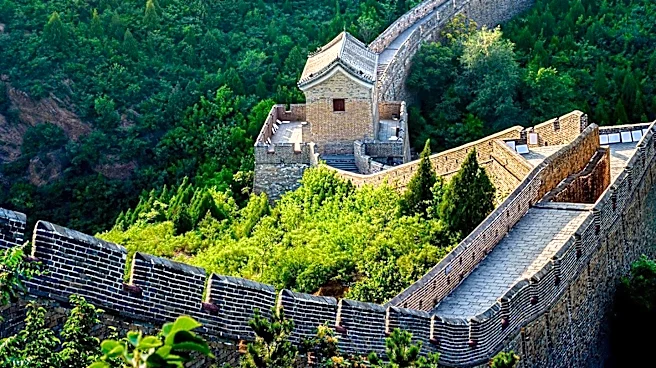









The unification of China under the Qin Dynasty in 221 BC marked a pivotal moment in its history, transforming it from a collection of feudal states into an authoritarian empire. This newfound power allowed the Qin to mobilize vast numbers of laborers for ambitious public works, including the initial extensive construction of what would become known as the Great Wall. Driven by a desire to define its northern borders and preemptively counter nomadic
threats, the Qin's wall-building efforts were monumental, yet fraught with immense challenges and ultimately contributed to widespread discontent that hastened the dynasty's downfall. The project highlights the complex interplay between imperial ambition, military strategy, and the human cost of such grand endeavors.
Unification and the Northern Frontier
After conquering the other Warring States, Qin Shi Huang, the first emperor of China, found his empire in possession of a large professional army with no internal enemies left to fight. This situation, combined with the Legalist reforms that had transformed China, enabled the Qin to command a far greater assembly of laborers than previous feudal kingdoms. In 215 BC, the emperor dispatched the renowned general Meng Tian to the Ordos region to expel the Xiongnu nomads who had settled beyond the northern frontier. This campaign was not a response to an immediate threat but rather a preemptive move to annex the ambiguous territories of the Ordos and clearly delineate the Qin's northern boundaries.
Once the Xiongnu were driven out, Meng Tian oversaw the settlement of 30,000 families to colonize these newly acquired lands. The existing wall configurations were then altered to align with the Qin's new borders. General Meng Tian connected the border walls of the former states of Qin, Zhao, and Yan, extending them beyond the northern loop of the Yellow River. Simultaneously, the walls that had previously divided the warring states within China were dismantled, as they were seen as threats to the empire's newfound unity, in stark contrast to the outer walls designed to stabilize the unified nation.
Construction Challenges and Human Cost
In 214 BC, Qin Shi Huang ordered the construction of new fortifications along the Yellow River to the west of the Ordos, while work continued in the north. This extensive building program was likely completed by 212 BC, a period marked by Qin Shi Huang's imperial inspection tour and the creation of the Direct Road, connecting the capital Xianyang with the Ordos. The result was a series of long walls stretching from Gansu to the seacoast in Manchuria. Official historical records lack detailed accounts of the construction, but it can be inferred that the conditions were exceptionally difficult due to the long stretches of mountains and semi-desert traversed by the Great Wall, the sparse populations in these areas, and the harsh, frigid winter climate.
While most of the walls were constructed from rammed earth, meaning the bulk of the building material was available on-site, the transportation of additional supplies and labor remained a significant challenge. The sinologist Derk Bodde, in *The Cambridge History of China*, suggests that for every man directly involved in construction, dozens more were likely needed to build access roads and transport supplies. This perspective is supported by the Han dynasty statesman Zhufu Yan's description of Qin Shi Huang's Ordos project in 128 BC. Yan noted that the land was brackish and arid, unsuitable for growing crops. Young men drafted for labor were forced to haul boats and barges upstream, laden with provisions, to maintain a steady supply of food and fodder for the front. He vividly described the inefficiency: a man and his animal starting with 176 kilograms of food might deliver only 29 kilograms by the time they reached their destination. The populace grew tired and weary, leading to dissipation and absconding. Orphans, the frail, the widowed, and the elderly desperately tried to escape their derelict state, dying by the wayside as they wandered from their homes, ultimately sparking widespread rebellion.
Abandonment and Legacy
The settlement efforts in the north continued until Qin Shi Huang's death in 210 BC. Following his death, a succession conspiracy led to Meng Tian being ordered to commit suicide. Before his death, Meng Tian expressed regret for his monumental work, stating, "Beginning at Lintao and reaching to Liaodong, I built walls and dug moats for more than ten thousand li; was it not inevitable that I broke the earth's veins along the way? This then was my offense." Meng Tian's northern settlements were subsequently abandoned, and the Xiongnu nomads returned to the Ordos Loop as the Qin empire became engulfed in widespread rebellion fueled by public discontent. Owen Lattimore concluded that the entire project, which relied on military force to impose agriculture on land better suited for herding, represented an "anti-historical paradox of attempting two mutually exclusive forms of development simultaneously" and was ultimately destined to fail. The Qin's ambitious wall-building, while laying the groundwork for future fortifications, ultimately underscored the immense human cost and the limitations of imperial power when faced with geographical realities and popular resistance.