



Utkatasana, commonly known as Chair Pose in modern yoga, has a rich history and a fascinating evolution in its form and interpretation. While today it is widely recognized as a standing posture resembling sitting in an imaginary chair, its origins suggest a different, more grounded squatting position. Understanding this progression offers insight into how yoga asanas adapt and are reinterpreted over time, reflecting changes in practice and teaching
methodologies.
The name Utkatasana itself provides clues to its powerful nature. Derived from Sanskrit, "utkaṭa" can mean "wild," "frightening," "above the usual," "intense," "gigantic," "furious," or "heavy." This suggests a pose that is not merely a gentle stretch but one that demands strength and focus, embodying a sense of intensity. The term "āsana" simply means "posture" or "seat." This etymology hints at a pose designed to be impactful, regardless of its specific physical manifestation.
Early Depictions and the Squatting Form
Historical texts reveal that the Utkatasana of earlier eras differed significantly from its contemporary counterpart. The 19th-century Sritattvanidhi, an important iconographic text, depicts an older version of the pose. In this depiction, the yogin is shown squatting much lower, closer to the heels. This form is reminiscent of Upaveshasana, another squatting posture, indicating that the original Utkatasana was a deeper, more grounded squat rather than the elevated, chair-like position seen today.
This earlier squatting form would have engaged the legs and core in a distinct way, emphasizing stability and a connection to the earth. The shift from this deep squat to the more upright chair pose highlights a reinterpretation of the posture's physical demands and aesthetic. It suggests a move towards a form that might be more accessible or that aligns with different pedagogical goals within modern yoga practices.
The Influence of Modern Yoga Pioneers
The modern, chair-like version of Utkatasana is largely attributed to Krishnamacharya, a pivotal figure in the development of modern yoga. His teachings and the subsequent dissemination of his methods by his pupils, such as B. K. S. Iyengar and Pattabhi Jois, profoundly shaped the practice of yoga as it is known today. Krishnamacharya's interpretation of Utkatasana, with its characteristic bent knees, hips back, and arms extended overhead, became widely adopted.
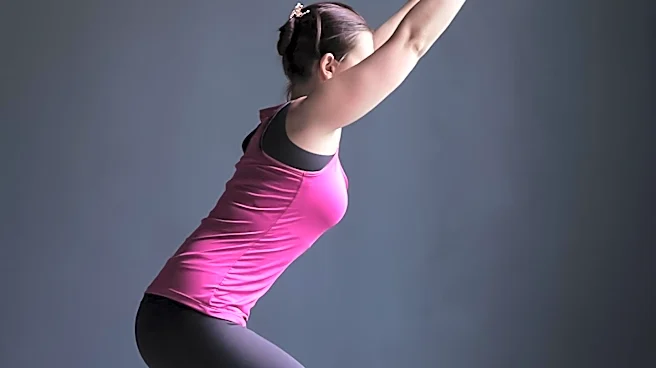
In this modern description, the knees are typically hips-width apart and bent, with the hips drawn back as if sitting. The chest is forward, and both arms are raised above the head, in line with the ears. The spine is elongated, and the sternum is lifted, creating a powerful and stimulating shape often compared to a lightning bolt. This contemporary form emphasizes strength in the legs and core, while also promoting an expansive quality in the upper body.
Exploring Variations of the Chair Pose
Beyond the basic modern Utkatasana, several variations have emerged, each offering a different challenge or focus. Ardha Utkatasana, for instance, involves bending the knees closer to a right angle, bringing the thighs more nearly parallel to the floor, and inclining the body further forward towards the thighs. This variation intensifies the leg work and deepens the engagement of the core.
Another significant variation is Parivritta Utkatasana, the rotated variant. In this pose, the hands are pressed together in front of the chest in Anjali Mudra, a prayer position. The lower elbow is then pressed against the outside of the opposite knee, and the gaze is directed upwards, adding a twisting element to the pose. These variations demonstrate the adaptability of Utkatasana, allowing practitioners to explore different aspects of strength, flexibility, and balance within the foundational structure of the pose.