






Mount Everest, the world's highest peak, is not only a marvel of elevation but also a fascinating study in geology and ecology. Its towering structure is a testament to immense tectonic forces, and despite its harsh, high-altitude environment, it supports a surprising array of life, from microscopic organisms to large mammals. Understanding the mountain's composition and its resident species offers a deeper appreciation for this iconic natural wonder.
Geological Formation and Composition
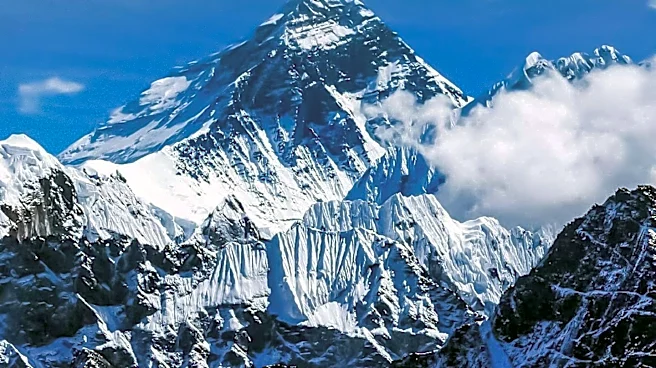
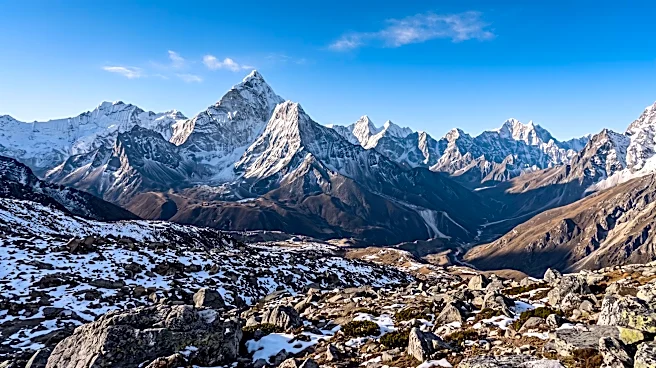
The geological makeup of Mount Everest is a direct result of the Cenozoic collision between the Indian Plate and the Eurasian Plate. This ongoing collision, driven by plate tectonics, has faulted sedimentary and metamorphic rocks southward over the Archean granulites of the Indian Plate, leading to the mountain's continuous uplift. Current interpretations suggest that the Qomolangma and North Col formations, which constitute much of Everest, are composed of marine sediments. These sediments accumulated on the continental shelf of the northern passive continental margin of India before its collision with Asia. The subsequent Cenozoic collision deformed and metamorphosed these strata, thrusting them southward and upward.Geologists have categorized the rocks of Mount Everest into three main formations: the Qomolangma Formation, the North Col Formation, and the Rongbuk Formation. These formations are separated by low-angle faults, known as detachments, along which they have been thrust over each other. The Qomolangma Formation, extending from the summit to the top of the Yellow Band (around 8,600 m or 28,200 ft), consists of greyish to dark grey or white, parallel laminated and bedded Ordovician limestone, interlayered with subordinate beds of recrystallized dolomite and siltstone. Microscopic fragments of trilobites, crinoids, and ostracods have been found in these limestones, indicating their marine origin. A thick, white-weathering thrombolite bed, 60 m (200 ft) thick, forms the base of the summit pyramid, composed of sediments bound by biofilms of microorganisms in shallow marine waters.
The bulk of Mount Everest, between 7,000 and 8,600 m (23,000 and 28,200 ft), is made up of the North Col Formation. The upper part of this formation, between 8,200 to 8,600 m (26,900 to 28,200 ft), is known as the Yellow Band, characterized by distinctive yellowish-brown diopside-epidote-bearing marble and muscovite-biotite phyllite. Below 7,000 m (23,000 ft), the Rongbuk Formation forms the base of Mount Everest, consisting of sillimanite-K-feldspar grade schist and gneiss, intruded by numerous leucogranite sills and dikes. These leucogranites formed about 20 to 24 million years ago from the partial melting of metasedimentary rocks during the subduction of the Indian Plate. Notably, the Ordovician Rocks of Mount Everest, recognized as fossiliferous marine limestone, were included in 2022 by the International Union of Geological Sciences as one of 100 geological heritage sites worldwide.
Flora and Fauna in an Extreme Environment
Despite the extreme conditions, Mount Everest supports a surprising, albeit sparse, array of flora and fauna. Very little native plant life exists directly on the mountain. However, a type of moss has been observed growing at 6,480 meters (21,260 ft), potentially making it the highest altitude plant species. An alpine cushion plant called Arenaria is known to grow below 5,500 meters (18,000 ft) in the region. Satellite data from 1993 to 2018 indicates that vegetation is actually expanding in the Everest region, with researchers finding plants in areas previously considered barren.Animal life, though limited, is also present. A minute species of black jumping spider, *Euophrys omnisuperstes*, has been found at elevations as high as 6,700 meters (22,000 ft), possibly making it the highest confirmed non-microscopic permanent resident on Earth. Another *Euophrys* species, *E. everestensis*, found at 5,030 meters (16,500 ft), may feed on insects blown there by the wind. Microscopic life is highly likely to exist at even higher altitudes. Larger animals include the bar-headed goose, which migrates over the Himalayas and has been seen flying at the mountain's higher altitudes, with one sighting near the summit in 1953. The chough, another bird species, has been spotted as high as the South Col at 7,906 m (25,938 ft), and yellow-billed choughs have been seen at 7,900 m (25,919 ft). Yaks are commonly used to haul gear for expeditions, capable of carrying around 100 kg (220 pounds), and are well-adapted with thick fur and large lungs. Other regional animals include the Himalayan tahr, a prey animal for the snow leopard, and the Himalayan black bear, found up to about 4,300 meters (14,000 ft). The red panda is also present in the region. One expedition even discovered a pika and ten new species of ants, highlighting the biodiversity that persists in this challenging environment.