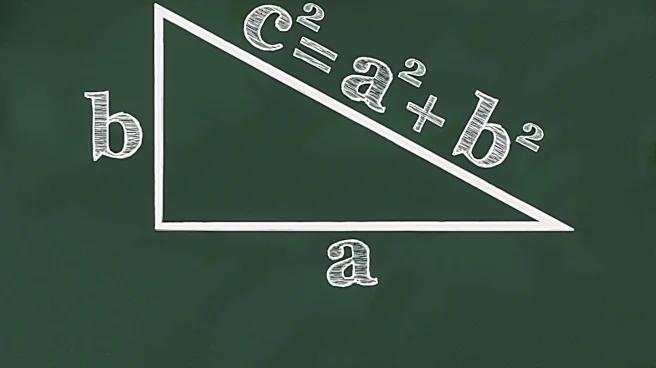








The Pythagorean theorem, a fundamental relation in Euclidean geometry, is most commonly known for its application to right triangles, stating that a² + b² = c². However, its principles extend far beyond the simple right triangle, finding generalizations in higher-dimensional spaces, non-Euclidean geometries, and even in abstract mathematical structures like inner product spaces. This foundational theorem serves as a special case of more general laws
and has profound implications for understanding distance, trigonometry, and the properties of various geometric and algebraic systems. Its adaptability makes it a powerful tool across diverse fields of mathematics and physics.
Generalizing to Similar Figures and Arbitrary Triangles
One significant generalization of the Pythagorean theorem extends beyond squares built on the sides of a right triangle to any similar figures. This concept was known to Hippocrates of Chios in the 5th century BC and was included in Euclid's Elements. It states that if similar figures are erected on the sides of a right triangle, then the sum of the areas of the figures on the two smaller sides equals the area of the figure on the hypotenuse. This holds true because the area of any plane figure is proportional to the square of any linear dimension. Thus, if similar figures with areas A, B, and C are built on sides a, b, and c respectively, then A/a² = B/b² = C/c². Since a² + b² = c², it follows that A + B = C.
The Pythagorean theorem is also a special case of the more general law of cosines, which applies to any triangle. The law of cosines states that a² + b² - 2ab cos(θ) = c², where θ is the angle between sides 'a' and 'b'. When the angle θ is 90 degrees (π/2 radians), cos(θ) becomes 0, and the formula simplifies directly to the Pythagorean theorem. Another generalization for arbitrary triangles, attributed to Thābit ibn Qurra, relates the sides of a general triangle by inscribing an isosceles triangle within it. This leads to the relation a² + b² = c(r + s), which reduces to the Pythagorean theorem when the angle is a right angle.
Extending to Higher Dimensions and Coordinate Systems
The utility of the Pythagorean theorem is evident in its application to coordinate systems and higher dimensions. In analytic geometry, Euclidean distance in a Cartesian coordinate system satisfies the Pythagorean relation: the squared distance between two points equals the sum of the squares of the differences in each coordinate. For two points (x₁, y₁) and (x₂, y₂) in a plane, the distance 's' is given by s² = (x₁ - x₂)² + (y₁ - y₂)².
This concept extends to Euclidean n-space, where the distance between two points A = (a₁, ..., aₙ) and B = (b₁, ..., bₙ) is defined as the square root of the sum of the squares of the differences in each coordinate. In solid geometry, the theorem can be applied repeatedly. For a cuboid, the length of a body diagonal AD can be found by applying the theorem twice: first to find a face diagonal AC (AC² = AB² + BC²), and then using AC and the perpendicular edge CD to find AD (AD² = AC² + CD²). This results in AD² = AB² + BC² + CD², a three-dimensional expression for the magnitude of a vector in terms of its orthogonal components. This can be viewed as a generalization to higher dimensions, though it is essentially a repeated application of the original theorem.
Abstract Generalizations: Inner Product Spaces and Beyond
The Pythagorean theorem finds a powerful generalization in inner product spaces, which are abstract vector spaces equipped with an inner product. In these spaces, the concept of perpendicularity is replaced by orthogonality, where two vectors 'v' and 'w' are orthogonal if their inner product is zero. The length of a vector is replaced by its norm. In an inner product space, the Pythagorean theorem states that for any two orthogonal vectors 'v' and 'w', ||v + w||² = ||v||² + ||w||². This form is a direct consequence of the properties of the inner product.
Further generalizations include the parallelogram law, which applies to non-orthogonal vectors in an inner product space, and states that 2||v||² + 2||w||² = ||v + w||² + ||v - w||². The Pythagorean identity can also be extended to sums of more than two orthogonal vectors. Another broad generalization applies to Lebesgue-measurable sets of objects in any number of dimensions. This "n-dimensional Pythagorean theorem" states that the square of the measure of an m-dimensional set of objects in n-dimensional Euclidean space is equal to the sum of the squares of the measures of the orthogonal projections of the object(s) onto all m-dimensional coordinate subspaces. These generalizations highlight the theorem's fundamental role in defining distance and relationships across various mathematical constructs.