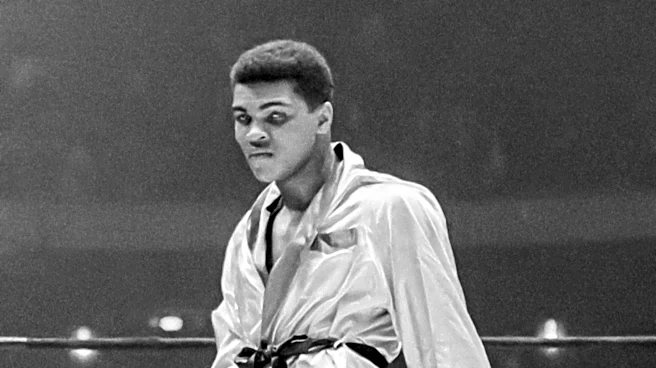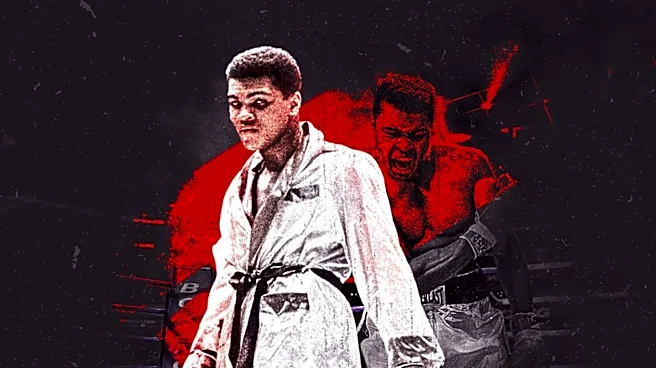






The professional boxing match between Muhammad Ali and Earnie Shavers, contested on September 29, 1977, for the undisputed heavyweight championship, stands out as a particularly demanding encounter in Ali's later career. This fight, which went the full distance, saw Ali secure a hard-fought unanimous decision. It was Ali's tenth title defense since he had regained the championship, underscoring his continued reign at the top of the heavyweight division.
The bout was broadcast in prime time by NBC, a network that rarely featured prime time fights, especially those involving Ali, which were more commonly shown on ABC. This decision by NBC to air the fight highlighted its anticipated significance and the draw of both fighters.
Pre-Fight Dynamics and Financial Stakes
Leading up to the fight, Muhammad Ali, nicknamed "The Greatest," entered the ring with a pre-fight record of 54 wins and 2 losses, including 37 knockouts. He was 35 years and 8 months old, standing at 6 feet 3 inches tall, and weighed 225 pounds. His opponent, Earnie Shavers, known as "The Black Destroyer," was 33 years old, 6 feet tall, and weighed 211 pounds, nearly 15 pounds less than the champion. Shavers' pre-fight record was an impressive 54 wins, 5 losses, and 1 draw, with a remarkable 52 knockouts, showcasing his reputation as a formidable puncher. Ali's cornerman, Angelo Dundee, even nicknamed Shavers "The Acorn" due to his shaved bald head.
Financially, the fight presented a significant disparity but also a career-high for Shavers. Ali commanded a purse of $3,000,000, while Shavers received one-tenth of that amount, $300,000. Despite being a fraction of Ali's earnings, this $300,000 sum was the largest amount Shavers had earned in his entire professional career up to that point, marking a substantial financial milestone for him. The fight was not just a contest for the WBA, WBC, and *The Ring* undisputed heavyweight championship, but also a major event for both fighters' legacies and financial standing.
The Unfolding Drama in the Ring
The fight itself was a testament to both Ali's resilience and Shavers' power. Ali was badly hurt in the second round by an overhand right from Shavers. However, Ali, known for his psychological tactics, pretended to be more severely hurt than he actually was. This deception led Shavers to hesitate, thinking Ali was play-acting, and prevented him from pressing for a knockout. Shavers continued to land hard shots to Ali's head and body throughout the fight, forcing the champion to box cautiously and maintain movement. Despite the continuous assault, Ali managed to finish many of the rounds strongly, which helped him win favor on the judges' scorecards.
As the fight progressed into the championship rounds, the intensity escalated. Shavers mounted a strong comeback in the 13th and 14th rounds, once again leaving Ali badly hurt but still on his feet. The final round was particularly close and dramatic. Shavers started the 15th round strong, landing several hard punches. However, the tide turned dramatically towards the end of the round. After an intense exchange of punches, Ali sent Shavers staggering back against the ropes, nearly knocking him to the canvas, and continued to land several clean punches until the final bell. This late surge by Ali showcased his incredible will and ability to perform under extreme pressure, even when exhausted.
Aftermath and Legacy of a Brutal Performance
Boxing experts widely regard Ali's victory over Shavers as one of the most impressive and brutal performances of his late boxing career. Sports Illustrated boxing writer Pat Putnam reflected on the fight, particularly the last round, as encapsulating Ali's essence, even past his prime. Putnam noted that Ali was ready to be taken out, given Shavers' devastating power, but Ali's cunning in faking injury prevented Shavers from going for the kill. He fought through fourteen grueling rounds, and the fifteenth round, according to Putnam, was as magnificent as any Ali ever fought. Despite being utterly exhausted after the fourteenth round, Ali found the strength and stamina to come out for the final round and fight three minutes as well as any three minutes Putnam had ever witnessed. Remarkably, late in that final round, Ali even had Shavers in trouble, with only the ropes preventing Shavers from going down.
This fight underscored Ali's legendary toughness and strategic brilliance, even as his physical prime was behind him. The ability to absorb such punishment, deceive a powerful opponent, and then rally in the final moments cemented the fight's place in boxing history. It was a testament to Ali's enduring spirit and his capacity to push beyond perceived limits, making it a memorable chapter in his storied career.