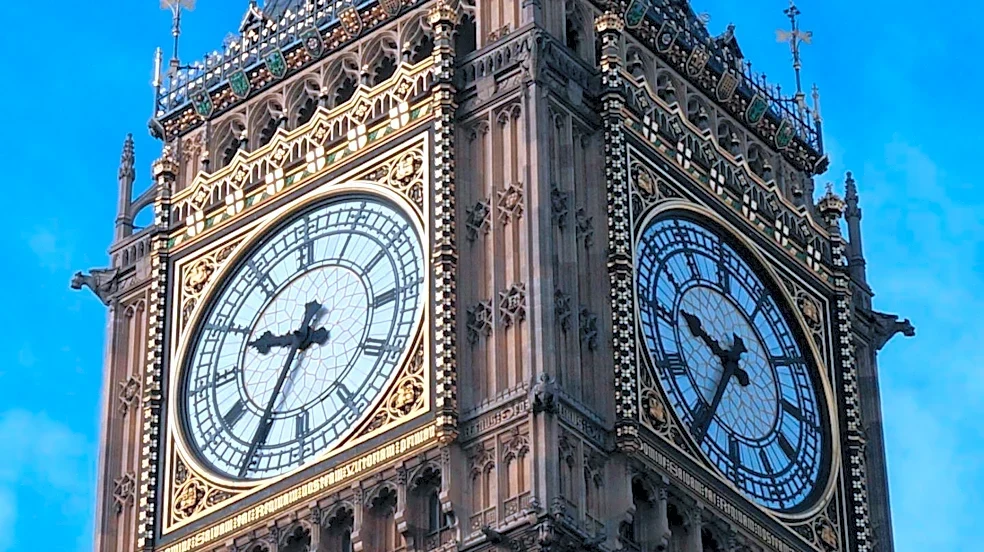










The Great Clock of Westminster, housed within the Elizabeth Tower, is renowned for its exceptional reliability and precision, a testament to the innovative engineering and meticulous craftsmanship of its creators. This complex mechanism, which includes the famous Great Bell nicknamed Big Ben, was designed with a stringent requirement: the first stroke of the hour bell had to be accurate to within one second per day, referenced to Greenwich Mean Time.
This commitment to accuracy has allowed the clock to maintain its reputation for keeping time to within a few seconds per week.
The design of the clock's movement was a collaborative effort between the lawyer and amateur horologist Edmund Beckett Denison and George Airy, the Astronomer Royal. Following the death of Edward John Dent, the clockmaker initially entrusted with its construction in 1853, his stepson Frederick Dent completed the work in 1854. The tower's delayed completion until 1859 provided Denison with ample time to refine the mechanism. He ultimately invented a double three-legged gravity escapement, a design that significantly improved the separation between the pendulum and the clock mechanism, thereby mitigating the effects of external elements like rain, wind, and snow on the dials. Denison never patented this groundbreaking design, and it quickly became the standard for high-quality tower clocks.
The Intricate Mechanism and Its Keepers
The clock's movement is hand-wound three times a week, a process that takes approximately 1.5 hours. Unlike many modern clocks, it does not rely on electricity for its primary function, except for winding and lighting the clock faces. The Keeper of the Clock holds the crucial responsibility of overseeing the movement and every aspect of maintenance within the Palace of Westminster. A dedicated team of horologists is on call 24 hours a day to address any emergencies, and they are also responsible for maintaining about 300 other clocks throughout the Palace.
One of the most fascinating aspects of the clock's precision adjustment involves a small stack of pre-decimal penny coins placed on top of the pendulum. Adding a coin subtly raises the pendulum's center of mass, effectively shortening its rod and increasing its swing rate. Conversely, removing a coin slows it down. Adding or removing a single penny can alter the clock's speed by 0.4 seconds per day. In 2009, three of these pennies were replaced with a commemorative £5 coin celebrating the upcoming 2012 Summer Olympics, highlighting the blend of tradition and contemporary events associated with the clock.
The Bells of Westminster: Sound and Structure
The belfry of the Elizabeth Tower houses not only the Great Bell, Big Ben, but also four quarter bells that play the distinctive Westminster Quarters. These quarter bells, sounding G#, F#, E, and B, were cast by John Warner & Sons in 1857 and 1858. Like the Great Bell, they are operated by the clock mechanism. Their sounds are produced by hammers pulled by cables from the link room, a low-ceilinged space between the clock room and the belfry, where they are triggered by the chime train. The Great Bell itself, officially known as the "Great Bell" and sounding an E-natural, is the largest bell in the tower.
The original Great Bell, weighing 16 tons, was cast in 1856 but cracked during testing. A replacement, weighing 13.5 tons, was cast at the Whitechapel Bell Foundry in 1858. This second bell, 7 feet 6 inches tall and 9 feet in diameter, was transported to the tower by sixteen horses and then pulled 200 feet up to the belfry, a feat that took 18 hours. It first chimed on July 11, 1859, but also cracked in September of the same year. The crack was repaired by chipping out a square piece of metal from the rim and rotating the bell so the hammer struck a different spot. This repair gave Big Ben its slightly different, unique tone, which it retains to this day. The striker, weighing 440 pounds, was replaced in 2007 and generates a sound intensity of 110–115 decibels inside the tower, necessitating ear protection for technicians.