







The East Ohio Gas Company, an American natural gas public utility, has a history stretching back to 1898. Incorporated by the Standard Oil group, its initial mission was to produce, transport, and market natural gas to cities throughout Ohio. Over the decades, the company expanded its operations, absorbing entities like the Cleveland Gas Light & Coke Company and the Peoples Gas Light Company in 1910, and increasing its capital significantly. While
it remained under the ownership of Standard Oil Company (New Jersey) until 1942, it was then transferred to a new holding company, Consolidated Natural Gas, which was later acquired by Dominion Energy in 2000. More recently, in March 2024, Enbridge acquired East Ohio and two other natural gas companies, leading to the company operating under the trade name Enbridge East Ohio.
Pioneering Liquefied Natural Gas Technology
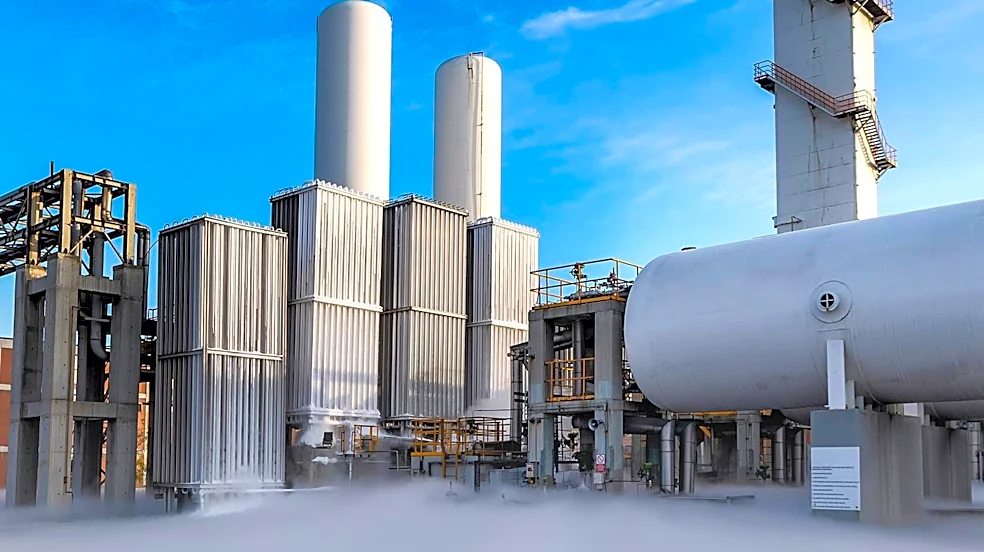
In the early 1940s, the East Ohio Gas Company played a pioneering role in the development of liquefied natural gas (LNG) technology. Following the success of a pilot plant built by its sister company, Hope Natural Gas Company of West Virginia, East Ohio Gas constructed the world's first full-scale commercial LNG plant in Cleveland, Ohio, in 1940. This innovative facility was designed to store natural gas in liquid form at an extremely low temperature of -260°F. The plant initially featured three spherical tanks, each with a capacity equivalent to approximately 50 million US gallons of natural gas. In 1942, a fourth tank, this one cylindrical and with a capacity of 100 million US gallons, was added. The purpose of this advanced storage system was to provide a reserve of gas that could be regasified and introduced into the main supply lines during periods of high demand, such as cold weather snaps, thereby ensuring a consistent supply for customers and preventing service interruptions.
The 1944 Explosion and Its Aftermath
Despite its innovative approach, the East Ohio Gas Company became tragically associated with a catastrophic event on October 20, 1944. At 2:30 p.m., the cylindrical storage tank number 4 began leaking vapor from a seam. This vapor, pushed by winds from Lake Erie, drifted into a mixed-use area of Cleveland and entered the sewer system. The gas ignited, causing a massive explosion that launched manhole covers into the air and sent flames shooting from sewer lines. A half-hour later, at 3:00 p.m., a second above-ground tank exploded, completely destroying the tank farm. The ensuing fires and explosions continued, devastating a square mile of the city, killing 131 people, injuring 225, and leaving over 700 homeless. The disaster also destroyed 79 homes, two factories, numerous vehicles, and extensive underground infrastructure.
Industry-Wide Repercussions and Legacy
The Cleveland East Ohio Gas explosion had far-reaching consequences, particularly for the natural gas industry. Prior to 1944, above-ground, low-pressure storage of natural gas was a common sight in urban areas across the U.S. However, the Cleveland tragedy served as a stark warning about the risks associated with such storage methods. In the wake of the disaster, utility companies and communities nationwide were compelled to re-evaluate their natural gas storage practices. This led to a significant shift away from above-ground tanks and a growing preference for below-ground storage systems, which were perceived as safer. The event underscored the critical importance of safety regulations and robust engineering in the handling of volatile energy resources, forever altering the landscape of natural gas storage and the legacy of the East Ohio Gas Company.