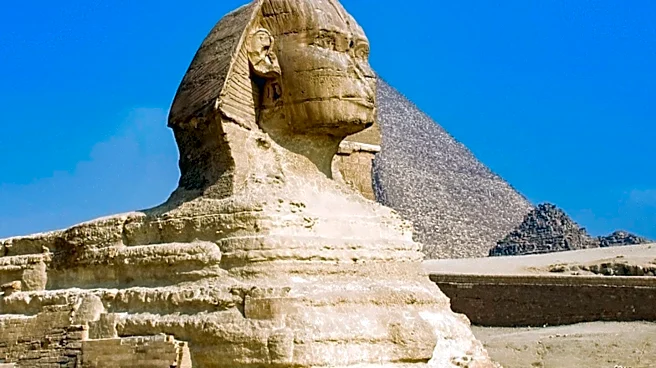







The Great Sphinx of Giza stands as one of the most iconic and enduring symbols of ancient Egypt. This colossal limestone statue, featuring the head of a human and the body of a lion, is a central feature of the Giza pyramid complex. Situated on the Giza Plateau, adjacent to the Great Pyramids and on the west bank of the Nile River, the Sphinx faces east, a silent sentinel overlooking the ancient landscape. While its exact construction date has been
a subject of debate, Egyptologists generally agree that the human head of the Great Sphinx bears the likeness of Pharaoh Khafre, placing its creation between 2600 and 2500 BC.
Location and Architectural Context
The Great Sphinx is an integral part of the larger Giza pyramid complex, which also includes the Great Pyramid, the Pyramid of Khafre, and the Pyramid of Menkaure. These monumental structures, along with their associated pyramid complexes, were all constructed during the Fourth Dynasty of the Old Kingdom of ancient Egypt, roughly between 2600 and 2500 BC. The Sphinx is specifically located southeast of the pyramids, forming a significant part of this ancient necropolis. The complex also encompasses several temples, cemeteries, and the remnants of a workers' village, highlighting the extensive planning and labor involved in its creation.
The Enigma of its Construction and Identity
Consensus among Egyptologists points to the head of the Great Sphinx being a representation of Pharaoh Khafre. This identification is crucial for dating the monument, placing its construction firmly within the period of his reign. However, a minority of geologists in the late 20th century proposed an alternative theory, citing evidence of water erosion in and around the Sphinx enclosure. They suggested that this erosion indicates the Sphinx predates Khafre, possibly dating back to 10,000 to 5000 BC. This claim, often referred to as the Sphinx water erosion hypothesis, remains a fringe theory within the broader field of Egyptology.
Associated Structures and Royal Connections
The Sphinx is not a standalone monument but is closely linked to the pyramid complex of Khafre. Khafre's complex includes a valley temple, the Sphinx temple, a causeway, a mortuary temple, and the king's pyramid. The valley temple of Khafre yielded several statues of the pharaoh, with some discovered in a well within the temple floor by Mariette in 1860, and others found during subsequent excavations. This intricate network of structures underscores the Sphinx's role within the royal funerary landscape, serving not only as a monumental statue but also as a component of a larger sacred precinct designed for the pharaoh's afterlife. The presence of five boat-pits and a subsidiary pyramid with a serdab further illustrates the comprehensive nature of Khafre's complex and the Sphinx's place within it.