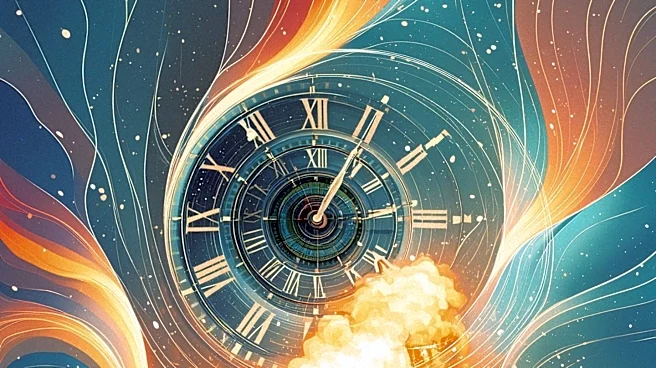






Time travel has long captivated the human imagination, serving as a cornerstone theme in fiction, particularly since the late 19th century. This enduring concept has been explored across various media, including literature, television, and film, giving rise to genres sometimes labeled as time-travel fiction, chrono fiction, temporal fiction, or chrono opera. At its heart, time travel fiction often delves into the profound consequences of journeys
into the past or future, frequently examining how altering history, whether intentionally or by accident, reshapes the present or future for the returning traveler.
Early Depictions: Time Slips and Supernatural Journeys
Before the advent of modern scientific theories, ancient stories often featured forms of time travel, typically into the future, through a phenomenon known as a time slip. This plot device usually involved protagonists experiencing a shift in time without their control or understanding, often brought on by traveling or sleeping. In these narratives, characters might find themselves marooned in a different era, forced to adapt, or eventually returned to their original time by an equally unpredictable process.
Beyond time slips, ancient fiction also depicted journeys into the past through supernatural means. Angels or spirits were sometimes invoked as agents of temporal displacement, allowing characters to witness or interact with historical events. These early forms of time travel were less about scientific mechanics and more about mystical or divine intervention, reflecting the worldview of their respective eras. The protagonist in such stories typically had no agency over the journey, highlighting a sense of fate or external power dictating their temporal fate.
The Rise of the Time Machine and Modern Concepts
The landscape of time travel fiction began to shift significantly with the introduction of more structured and often technologically driven methods. While ancient tales relied on inexplicable time slips or supernatural forces, the late 19th century marked a turning point. The 1843 novel *A Christmas Carol* by Charles Dickens is notable for being one of the first to include both travel to the past and the future, with a return to the present, albeit through spectral guidance rather than a mechanical device.
Modern fiction, particularly science fiction, has increasingly incorporated scientific theories into its portrayal of time travel. Concepts like space and time warps, derived from the scientific theory of general relativity, have become common mechanisms. These more sophisticated explanations offer a pseudo-scientific basis for temporal journeys, moving away from purely mystical explanations. The development of the "time machine" as a device became another central plot device, offering a tangible means for characters to control their temporal movements, contrasting sharply with the uncontrolled nature of earlier time slips.
Time Portals and Paradoxes
Another significant mechanism in time travel fiction is the time portal or time gate. Unlike mobile time machines, these are often depicted as permanent or semi-permanent fixtures, serving as doorways in time that transport characters to specific points in the past or future. These portals are employed across various genres, including science fiction and fantasy, providing a fixed point of entry and exit for temporal adventurers.
An influential example of a work featuring a time gate is Robert A. Heinlein's short story, "By His Bootstraps." This story not only utilizes a time gate, built by aliens, but also delves into some of the inherent paradoxes that time travel could cause. The exploration of paradoxes—such as altering one's own past or creating causal loops—is a central theme in many time travel narratives, adding layers of complexity and philosophical inquiry to the genre. Whether through time slips, time machines, or time portals, the core fascination remains the profound impact of temporal displacement on individuals and history itself.