In Buddhist iconography, mudras serve as a profound visual language, conveying specific moments, teachings, and attributes of the Buddha and other deities. These symbolic hand gestures, often combined with various asanas (seated postures), act as a shorthand, allowing viewers to immediately grasp the narrative or spiritual significance of an image. While some mudras are shared with Hindu traditions, Buddhist mudras often carry distinct meanings tied
to the life and teachings of Gautama Buddha. Their use extends beyond South Asia, with many developing unique local forms in different regions where Buddhism flourished.
The Gesture of Fearlessness: Abhaya Mudrā
The Abhaya mudrā, meaning "gesture of fearlessness," is one of the most recognizable Buddhist mudras. It symbolizes protection, peace, benevolence, and the dispelling of fear. In Theravada Buddhism, the Buddha is typically depicted standing, with the right arm bent and raised to shoulder height, the palm facing forward, fingers together and pointing upright, while the left hand rests by the side. In Thailand and Laos, this mudra is associated with the Walking Buddha, sometimes shown with both hands forming an identical double Abhaya mudrā. This gesture likely predates Buddhism, used as a sign of goodwill when approaching strangers. In Gandharan art, it signifies preaching, and it was also adopted in China during the Wei and Sui dynasties. A notable instance of its use is by the Buddha to subdue an attacking elephant, a scene depicted in various frescoes and scripts. In Mahayana Buddhism, deities often pair the Abhaya mudrā with another mudrā in the other hand.
Earth Witness: Bhūmisparśa Mudrā
The Bhūmisparśa mudrā, or "earth witness" mudra, is among the most common iconic images of Buddhism, particularly associated with Gautama Buddha. Also known as "Buddha calling the earth to witness" or "earth-touching," it illustrates the pivotal moment of Buddha's enlightenment. In this depiction, Buddha sits in meditation with his left hand, palm upright, in his lap, and his right hand touching the earth. The legend recounts that when challenged by the evil Mara to provide a witness to his right to achieve enlightenment, Buddha touched the ground. In response, Phra Mae Thorani, the earth goddess, appeared to attest to his enlightenment. In East Asian representations, sometimes called the Maravijaya attitude, Buddha's fingers may not reach the ground, differing from Burmese or Indian depictions.
The Wisdom Fist: Bodhyangi Mudrā
The Bodhyangi mudrā, also known as the "mudrā of the six elements" or the "fist of wisdom," is a gesture where the left-hand index finger is grasped by the right hand. This mudra is frequently observed on statues of the Vairocana Buddha, signifying the unity of the five elements with consciousness, or the wisdom that arises from this integration. It represents a powerful symbol of enlightenment and the interconnectedness of all phenomena.
Turning the Wheel of Dharma: Dharmachakra Pravartana Mudrā
The Dharmachakra Pravartana mudrā, meaning "turning of the wheel," commemorates the Buddha's first sermon after his Enlightenment in Deer Park in Sarnath. This mudra generally depicts only Gautama Buddha, with Maitreya also shown as a dispenser of the Law. It involves both hands held close together in front of the chest in a vitarka gesture, with the right palm forward and the left palm upwards, sometimes facing the chest. Variants exist, such as in the Ajanta Caves frescoes where hands are separated, or in the Indo-Greek style of Gandhara where the right hand's clenched fist overlies the left hand's joined fingers. In Japan, particularly in pictorials of Hōryū-ji, the right hand is superimposed on the left. Certain figures of Amitābha in Japan used this mudra before the 9th century.
The Gesture of Meditation: Dhyāna Mudrā
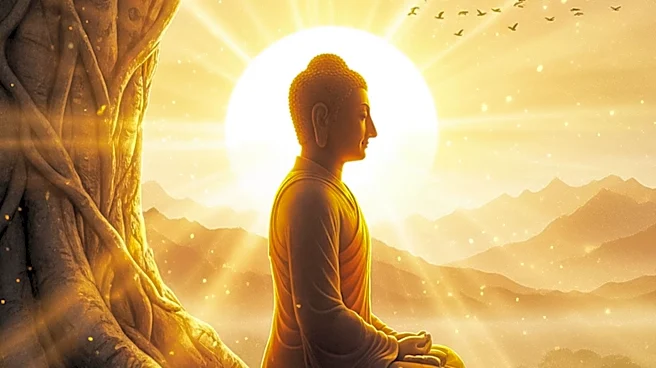
The Dhyāna mudrā, or "meditation mudra," is the gesture of meditation, symbolizing the concentration of the Good Law and the sangha (community). Both hands are placed on the lap, with the right hand resting on the left and fingers fully extended. The four fingers rest on each other, and the thumbs face diagonally upward towards each other, palms facing upwards. This forms a triangle, symbolizing spiritual fire or the Three Jewels. This mudra is seen in representations of Gautama Buddha and Amitābha. Sometimes, in depictions of Bhaiṣajyaguru as the "Medicine Buddha," a medicine bowl is placed on the hands. Originating in India, likely Gandhara, and later appearing in China during the Northern Wei dynasty, it is widely used in Southeast Asian Theravada Buddhism, where thumbs are placed against the palms. Also known as "samādhi mudrā" or "yoga mudrā," a Japanese variation, mida no jōin, brings the index fingers together with the thumbs, primarily to distinguish Amitābha from Vairocana Buddha.