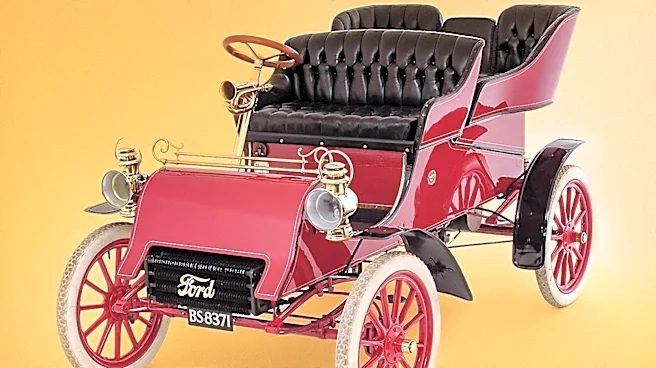







The Ford Model T, first produced in 1908, was a marvel of engineering simplicity that contributed significantly to its success as the first reliable, easily maintained, mass-market automobile. Designed by a team including Childe Harold Wills, Joseph A. Galamb, and Eugene Farkas, under the supervision of Henry Ford, the Model T prioritized robustness and straightforward mechanics. This design philosophy ensured that the car was not only affordable
to purchase but also practical for the average owner to operate and maintain, even on the challenging roads of the early 20th century.
Robust Construction for Demanding Conditions
The Model T's suspension system was a testament to its rugged design, employing a transversely mounted semi-elliptical spring for both the front and rear beam axles. This setup allowed for considerable wheel movement, essential for navigating the unpaved dirt roads prevalent at the time. The front axle, notably, was drop-forged as a single piece of vanadium steel, a material chosen for its exceptional strength. Ford famously demonstrated this by twisting many axles through eight full rotations (2880 degrees) and displaying them at dealerships to highlight their superior durability.
Braking on the Model T was also designed with simplicity in mind, though it differed significantly from modern systems. It lacked a contemporary service brake; instead, the right foot pedal activated a band around a drum within the transmission, which in turn stopped the rear wheels. A parking brake lever operated band brakes on the inside of the rear brake drums, integrated into the rear wheel hubs. While aftermarket suppliers offered optional brakes that acted on the outside of the brake drums, the standard system was effective for its era. The car's wheels were initially wooden artillery wheels, with steel welded-spoke wheels becoming available in its later years, specifically 1926 and 1927.
Engine and Fuel System: Practicality Over Complexity
The Model T engine, an inline-4 with a 177 cubic inch (2.9 L) displacement, was built as a gasoline engine but its simple, robust design allowed it to run on various combustible fuels, including benzene, ethanol, or kerosene, if modified. It produced 20 horsepower and offered fuel economy ranging from 13–21 miles per gallon. The engine's cooling system also reflected the T's simplicity; after the first few hundred models, the water pump was eliminated in favor of a more reliable and cheaper thermosyphon system. This system relied on hot water rising to the top of the engine and into the radiator, then descending as it cooled, circulating back into the engine without the need for a pump.
The fuel system was equally straightforward, featuring a single-venturi carburetor with manual choke and throttle controls operated by a hand lever rather than a foot pedal. For most of its production, the 10-gallon fuel tank was located under the front seat. Because fuel was gravity-fed to the carburetor, a Model T might struggle to climb steep hills with low fuel levels, leading to the common practice of driving up such inclines in reverse. In 1926, the fuel tank was moved forward and upward, under the cowl, behind the dashboard on most models, improving the gravity feed. This practical, no-frills engineering ensured the Model T remained a dependable and accessible vehicle for millions.