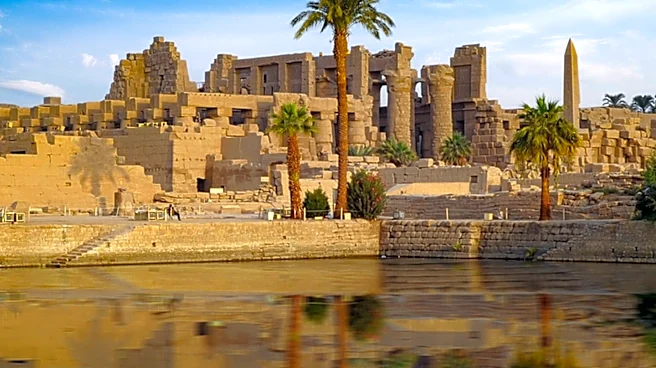







Luxor, often called the "world's greatest open-air museum," is a city in Upper Egypt renowned for its extraordinary architectural heritage. Within the modern urban landscape, the ruins of the ancient Egyptian temple complexes at Karnak and Luxor stand as monumental testaments to a glorious past. Across the Nile River, the West Bank Theban Necropolis further expands this architectural marvel, encompassing the Valley of the Kings and the Valley of the Queens.
These structures, built with meticulous craftsmanship and profound symbolism, are not merely historical relics but integral parts of Luxor's identity, drawing millions of visitors annually.
The Grandeur of Temple Complexes
The Luxor Temple, constructed around 1400 BCE, is a prime example of ancient Egyptian architectural prowess. Known in the Egyptian language as *ipet resyt*, or "the southern sanctuary," it was one of two main temples on the east bank of the Nile, the other being the vast Karnak Temple. Unlike many other temples in Thebes, the Luxor Temple was not dedicated to a cult god or a deified pharaoh in death. Instead, it was dedicated to the rejuvenation of kingship, possibly serving as a site where many pharaohs were crowned, either literally or symbolically.
The construction of the Luxor Temple utilized sandstone from the Gebel el-Silsila area, known as Nubian sandstone, a material commonly used for monuments in Upper Egypt. A notable architectural technique employed was illusionism. For instance, the two obelisks flanking the entrance of the Luxor Temple were not of equal height, yet they were designed to create the illusion of being the same height when viewed from certain perspectives. This visual and spatial effect emphasized the pathway and enhanced the perceived grandeur of the structure. The temple also features colossal seated figures of Ramesses II, which are considered Ka-statues, embodying the royal Ka or spirit of the king.
Connecting Sacred Spaces: The Avenue of Sphinxes
An impressive architectural feature connecting the Luxor Temple with the Karnak Temple is the Avenue of Sphinxes. This avenue, known as *wi.t ntr* or "path of god," stretched for approximately 2.7 kilometers (1.7 miles) and was lined with human-headed sphinxes. It is believed that these sphinxes replaced earlier versions that might have had different heads. Along this sacred pathway, six barque shrines were strategically placed. These shrines served as way stations for the barques of the gods during festival processions, such as the significant Feast of Opet.
Each station along the Avenue of Sphinxes had a specific ceremonial purpose. For example, the fourth station, Kamare, was where the oar of Amun was cooled, while the fifth station was dedicated to receiving the beauty of Amun. The sixth station of Kamare served as a shrine for Amun, known as "Holy of Steps." This elaborate processional route underscores the deep religious and architectural planning that characterized ancient Thebes, creating a unified sacred landscape.
Integration and Evolution: From Ancient to Modern
The architectural legacy of Luxor is not confined to ancient ruins; it is deeply integrated into the fabric of the modern city. From the Middle Ages, the population of Luxor settled in and around the temple areas, leading to centuries of accumulated rubble that formed an artificial hill up to 14.5 to 15 meters (48 to 49 feet) high over parts of the Luxor Temple. Excavations, notably by Professor Gaston Maspero after 1884, gradually uncovered these buried structures, revealing courts and colonnades that formed the core of the Arab half of the modern village.
Remarkably, a working mosque, the Abu Haggag Mosque, still stands within the Luxor Temple, built upon ancient columns. This part of the temple was converted into a church by the Romans in 395 CE and then into a mosque around 640 CE, representing over 3,400 years of continuous religious worship within the same sacred space. This unique integration of ancient and modern religious structures, alongside the preservation of monumental temples and tombs, makes Luxor a living testament to architectural continuity and cultural evolution.