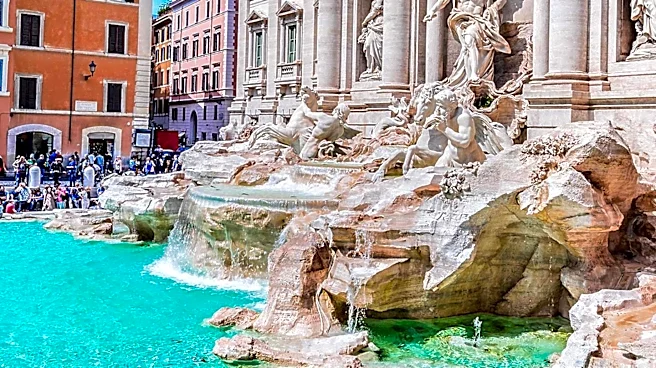







The Trevi Fountain, an iconic 18th-century landmark in Rome, Italy, stands as a testament to both artistic grandeur and the remarkable engineering of ancient Rome. Designed by Nicola Salvi and completed by Giuseppe Pannini in 1762, this Baroque masterpiece is not merely a decorative feature but marks the terminal point of the "modern" Acqua Vergine. This aqueduct, a revived version of the ancient Aqua Virgo, has continuously supplied water to the city
for over two millennia, connecting the fountain directly to a rich historical lineage that began with the Roman Empire.
Ancient Origins and Continuous Supply
The story of the Trevi Fountain's water supply begins in 19 BC. According to legend, Roman technicians, with the help of a virgin, discovered a source of pure water approximately 8.1 miles from the city. This discovery led to the construction of the Aqua Virgo aqueduct. While the direct distance was 8.1 miles, the aqueduct's indirect route stretched to about 14 miles, bringing water to significant Roman structures like the Baths of Agrippa. This vital water system served Rome for more than 400 years, demonstrating the advanced capabilities of Roman engineering.
Even after the decline of the Roman Empire, the Acqua Vergine proved remarkably resilient. During the 6th century AD, many of Rome's 14 functioning aqueducts suffered damage during the Ostrogoth invasion and were not well maintained. However, the Acqua Vergine, though compromised and reduced in scope after the siege of the Goths of Vitiges in 537, remained in use throughout the Middle Ages. Records show restorations as early as the 8th century, and again by the Municipality in the 12th century. During these medieval restorations, the conduit was even connected to other water sources closer to the city, located in a place then called "Trebium," which some believe might be the origin of the fountain's name.
From Ancient Aqueduct to Baroque Masterpiece
The Acqua Vergine aqueduct continues to carry water to the Trevi Fountain today, collecting it from a source 6.2 miles from the Italian capital. This continuous operation is a remarkable feat, especially considering the age of the system. The aqueduct has undergone interventions over the centuries, during which the fountain sometimes remained empty, but its fundamental function has persisted. The purity of its calcium-free water is even thought to be a contributing factor to its longevity.
When Nicola Salvi designed the Trevi Fountain in the 18th century, he ingeniously incorporated it into the existing urban fabric. A palace, now known as the Palazzo Poli, already stood on the site. Salvi integrated the fountain into the rear of this building, making it an integral part of the architecture rather than a freestanding structure. This design choice further cemented the fountain's connection to its historical surroundings and the enduring presence of the ancient water supply it celebrates. The fountain's impressive scale, standing 86 feet high and 161.3 feet wide, makes it the largest Baroque fountain in Rome and a globally recognized symbol of the city's rich past and continuous vitality.