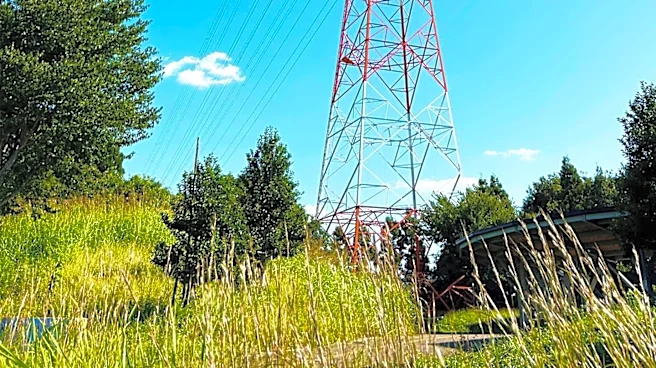








Overhead power lines represent a foundational element of modern electrical infrastructure, serving as the primary means for bulk transfer and distribution of electricity across vast distances. These above-ground structures, consisting of conductors suspended by towers or poles, are a testament to engineering ingenuity. Their design leverages the insulating properties of air and allows for visual inspection, making them generally the most cost-effective
method for transmitting large quantities of electrical energy. The continuous evolution of these systems, from early telegraph lines to ultra-high voltage grids, underscores their critical role in powering societies worldwide.
A Historical Journey of Electrical Transmission
The concept of transmitting electrical impulses over extended distances dates back to July 2, 1729, when physicist Stephen Gray, in collaboration with Granville Wheler, demonstrated this using damp hemp cords suspended by silk threads. While the distinction between conductors and insulators was not yet fully understood, this marked an early step. The first practical application of overhead lines emerged with telegraphy, with experimental commercial telegraph systems extending up to 13 miles by 1837.
Electric power transmission itself began in 1882 with the first high-voltage transmission between Munich and Miesbach, covering 60 kilometers. A significant leap occurred in 1891 with the construction of the first three-phase alternating current overhead line between Lauffen and Frankfurt for the International Electricity Exhibition. The early 20th century saw rapid advancements: the first 110 kV overhead power line entered service in 1912, followed by the first 220 kV line in 1923. RWE AG further pushed boundaries in the 1920s by building the first overhead line for this voltage and constructing a Rhine crossing with 138-meter-high pylons in 1926. The United States saw its first 345 kV line commissioned by American Electric Power in 1953. Sweden, in 1952, inaugurated a 380 kV line spanning 625 miles to connect hydroelectric power stations in the north with populated southern areas. By 1957, Germany commissioned its first 380 kV overhead power line, and Italy's overhead line traversing the Strait of Messina, featuring pylons that served as a model for later projects like the Elbe crossing 2, also went into service. Starting in 1967, Russia, the USA, and Canada began building 765 kV lines. A monumental achievement was the 1150 kV three-phase alternating current line built in the Soviet Union between Kokshetau and Ekibastuz in 1985. Japan introduced its first 1000 kV power line with two circuits, the Kita-Iwaki Powerline, in 1999. The 21st century has seen innovations like replacing steel with carbon fiber cores to increase transmission capacity without requiring more land, and China's Yangtze River Crossing, with its 346.5-meter-high suspension towers, began service in 2004.
Construction and Classification of Modern Power Lines
Modern overhead power lines are constructed with various materials for their support structures, including wood (both natural and laminated), steel or aluminum (as lattice structures or tubular poles), concrete, and occasionally reinforced plastics. The bare wire conductors are typically made of aluminum, sometimes reinforced with steel or composite materials like carbon and glass fiber. Copper wires are still used in some medium-voltage distribution and low-voltage connections. A primary design objective is to maintain adequate clearance between energized conductors and the ground to prevent dangerous contact, while also ensuring reliable support and resilience against environmental factors such as storms, ice loads, and earthquakes.
Overhead power transmission lines are classified by their operating voltage ranges. Low voltage (LV) lines, less than 1000 volts, connect residential or small commercial customers to the utility. Medium voltage (MV) lines, ranging from 1 kV to 69 kV, are used for distribution in urban and rural areas. High voltage (HV) lines, including subtransmission and transmission at voltages like 115 kV and 138 kV, handle bulk quantities of electric power and connect to very large consumers. Extra high voltage (EHV) lines, from 345 kV up to about 800 kV, are designed for long-distance, very high-power transmission. Ultra high voltage (UHV) lines, exceeding 800 kV, are considered a "game changer" by some, potentially enabling a global electricity grid. StateGrid reports that UHV lines can transmit five times more power over six times the distance compared to conventional lines.
Insulators and Compact Line Designs
Insulators are crucial components that support conductors and withstand both normal operating voltages and surges from switching and lightning. They are broadly categorized as pin-type, supporting the conductor above the structure, or suspension-type, where the conductor hangs below. The invention of the strain insulator was pivotal for higher voltage applications. While both types are common up to about 33 kV (69 kV in North America), only suspension-type insulators are typically used for higher voltages. Insulators are commonly made of wet-process porcelain or toughened glass, with increasing use of glass-reinforced polymer insulators, which offer lower cost and lighter weight, especially at higher voltages. China has developed polymer insulators for 1100 kV systems, and India is working on 1200 kV lines.
Suspension insulators consist of multiple units, with the number of disks increasing with higher voltages, lightning withstand requirements, altitude, and environmental factors like fog or pollution. Longer insulators with greater creepage distance are used in suboptimal conditions. Strain insulators must be mechanically robust to support the full weight of the conductor span, along with ice and wind loads. Some porcelain insulators feature a semi-conductive glaze to warm the surface, reducing the effects of fog and dirt, and ensuring even voltage distribution. Polymer insulators, with their hydrophobic characteristics, offer improved wet performance and require less specific creepage distance than porcelain or glass. For very high voltages (over 200 kV), grading rings may be installed to improve electric field distribution and resistance to flash-over during surges.
Compact transmission lines are designed to require a smaller right-of-way than standard lines. This is achieved by either using short span lengths with insulating crossbars or by separating conductors within the span using insulators. The former is simpler to build as it avoids the complexities of installing and maintaining in-span insulators. These compact designs can also be used to upgrade existing lines to higher voltages, increasing power transmission capacity within the same right-of-way. These advancements continue to shape the efficiency and reach of electrical grids.