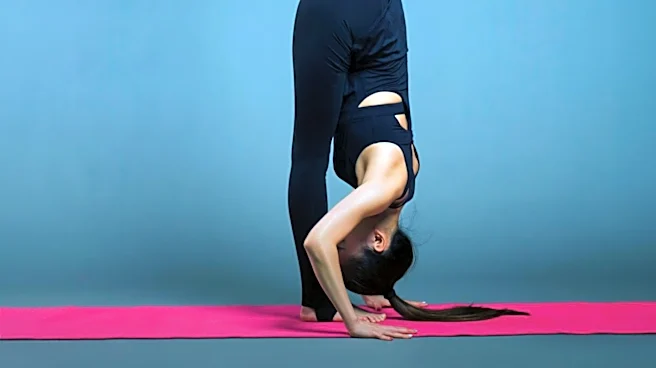









Ardha Hanumanasana, a yoga pose also known as the half-split, is a foundational posture that prepares practitioners for the full front split, Hanumanasana. The name itself provides insight into its nature: "Ardha" is a Sanskrit term meaning "half." This indicates that Ardha Hanumanasana is a preparatory or modified version of the complete split. While the full front split, Hanumanasana, involves extending both legs fully in opposite directions, the half-split offers
a more accessible entry point, focusing on flexibility and alignment in a controlled manner. Understanding this pose involves recognizing its Sanskrit roots, its variations across different yoga traditions, and the physical mechanics of its execution.
Understanding the Sanskrit Terminology
The Sanskrit language is rich with descriptive terms that define yoga postures, or asanas. In the case of Ardha Hanumanasana, the prefix "Ardha" clearly signifies "half." This is a common practice in yoga terminology, where prefixes are used to denote variations or modifications of a primary pose. For instance, other Sanskrit terms like "Adho" mean "downward," "Eka" means "one" or "single," "Parivrtta" means "revolved" or "twisted," and "Urdhva" means "upward." These prefixes help practitioners understand the nature and direction of a pose, making the vast array of asanas more comprehensible.
Ardha Hanumanasana is directly related to Hanumanasana, which is the full front split. Hanumanasana itself is named after Hanuman, a revered deity in Hindu mythology known for his strength and ability to leap great distances. The pose is said to emulate Hanuman's legendary leap, symbolizing courage and devotion. By understanding that "Ardha" means "half," practitioners can immediately grasp that Ardha Hanumanasana is a less intense version, focusing on building the necessary flexibility and strength gradually before attempting the full expression of the pose.
Variations Across Yoga Traditions
Different yoga traditions often have unique names or approaches to similar postures. Ardha Hanumanasana, or the front split, is no exception. In Kripalu yoga, for example, the pose known as Hanumanasana is referred to as the "Runner's Stretch." This alternative name highlights the practical application of the stretch, as it targets muscles commonly used and tightened in running, such as the hamstrings and hip flexors. This demonstrates how different schools of yoga may emphasize either the mythological or the functional aspects of a pose.
Another notable variation comes from Ashtanga Vinyasa Yoga. In this dynamic and rigorous style, a front split is specifically named Samakonasana. This illustrates that while the physical execution of the pose might be similar across traditions, the nomenclature can vary significantly. These differences in naming conventions can sometimes lead to confusion but also reflect the diverse historical and philosophical lineages within yoga. Regardless of the name, the core action of extending one leg forward and the other to the rear of the torso remains central to the practice of this half-split and its full expression.
Executing the Half-Split
The execution of Ardha Hanumanasana involves a specific alignment to safely and effectively stretch the relevant muscle groups. The pose is performed by extending one leg forward and the other leg to the rear of the torso. This action targets the hamstrings of the front leg and the hip flexors of the back leg, promoting flexibility in these areas. The goal is to gradually increase the range of motion in the hips and legs, preparing the body for deeper stretches.
While the full front split, Hanumanasana, requires significant flexibility, particularly in the iliofemoral ligament, Ardha Hanumanasana allows practitioners to work within their current capabilities. The "half" aspect implies that the hips may not be fully squared or lowered to the ground, providing a gentler stretch. Proper alignment and gradual progression are key to avoiding strain and injury. The focus is often on maintaining a long spine and engaging the core, rather than forcing the body into a position it is not yet ready for. This mindful approach is characteristic of many yoga practices, emphasizing awareness and respect for the body's limits.