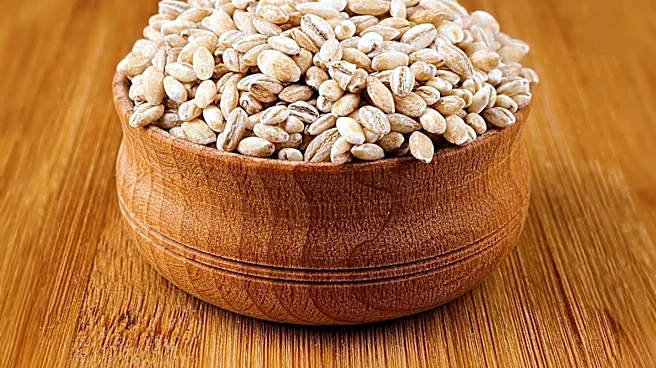









Barley, a member of the grass family, stands as a testament to early agricultural innovation, having been one of the first grains cultivated by humans. Its domestication in the Fertile Crescent around 9000 BC marked a significant turning point in human history, transforming it from a wild plant into a crucial food source. This early cultivation led to the development of nonshattering spikelets, a characteristic that made harvesting much more efficient
and contributed to its widespread adoption. From its origins, barley's utility and adaptability allowed it to spread across Eurasia, becoming a staple crop by 2000 BC.
The Origins of Domestication and Early Spread
The domestication of barley is believed to have occurred approximately 10,000 years ago in the region encompassing Israel and Jordan within the Fertile Crescent. Archaeological evidence, including barley grains found at various sites in this area, supports this theory. Furthermore, wild barley populations in this specific region show a closer molecular similarity to cultivated barley's gene pool than any other wild populations, reinforcing its role as the primary origin point.
Initially, it was hypothesized that barley underwent multiple domestication events across its range. However, advanced AFLP technology suggests a single domestication event. Subsequent research, analyzing haplotype frequency across different geographic areas, indicates at least two distinct domestication events. One occurred in the Fertile Crescent, giving rise to the cultivars commonly grown in Europe and America today. The second event took place thousands of kilometers further east, contributing to the diverse cultivated crops found in Central Asia and the Far East.
Adapting to Diverse Climates and Cultivation Practices
Barley thrives in temperate climates and prefers relatively low temperatures and well-drained soil. While it is less winter-hardy than wheat or rye, it demonstrates a notable tolerance for drought and soil salinity, allowing it to be cultivated in a variety of environments. The wild form of barley, *Hordeum spontaneum*, shares many similarities with its cultivated counterpart, *Hordeum vulgare*, though wild barley typically features narrower leaves, longer stems, and a brittle rachis that aids in seed dispersal.
In ancient Israel and Palestine, the agricultural cycle for barley was well-established. The ground was prepared for sowing in December, with the actual planting occurring in January. The harvest of barley typically took place in April, highlighting its importance in the seasonal agricultural calendar of the region. This consistent cultivation over millennia underscores barley's enduring value as a resilient and productive crop.
Morphological Evolution and Classification
Over time, the cultivation of barley led to distinct morphological changes, particularly in the structure of its spikelets. Wild barley, and other Old World *Hordeum* species, typically have only a central fertile spikelet within each cluster, a characteristic retained in what are now known as two-row barleys. However, a pair of mutations, one dominant and one recessive, resulted in fertile lateral spikelets, leading to the development of six-row barleys.
Historically, these different forms were classified as separate species based on their morphological differences. For instance, two-row barley with shattering spikes was called *Hordeum spontaneum*, while two-row barley with nonshattering spikes was *H. distichon*. Six-row barley with nonshattering spikes was known as *H. vulgare* (or *H. hexastichum*), and six-row with shattering spikes as *H. agriocrithon*. Modern classifications, however, recognize these forms as a single species, *H. vulgare*, due to the understanding that these variations are primarily driven by single-gene mutations, supported by cytological and molecular evidence. This unified classification reflects the grain's shared genetic heritage despite its diverse appearances and uses.