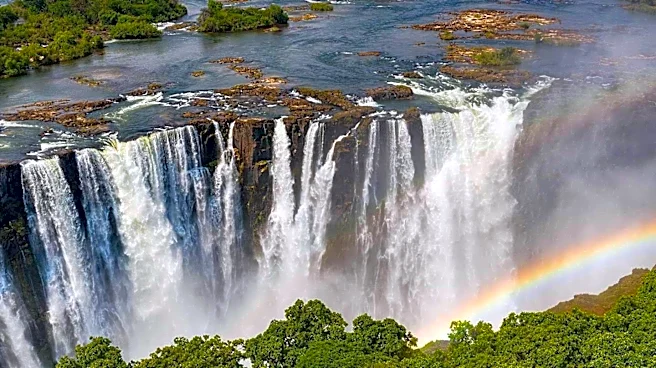








Victoria Falls National Park, situated in north-western Zimbabwe, serves as a vital protector of the Zambezi River's south and east banks, specifically in the vicinity of the world-renowned Victoria Falls. This park is not merely a scenic overlook; it is a significant ecological zone that stretches along the Zambezi River. Its boundaries extend approximately 6 kilometers upstream from the falls, connecting with the larger Zambezi National Park, and continue
for about 12 kilometers downstream. This strategic location ensures the preservation of a diverse ecosystem influenced by the powerful waterfall.
The park's governance falls under the Zimbabwe Parks and Wildlife Management Authority, highlighting its importance in the nation's conservation efforts. It is classified as an IUCN category II national park, signifying its primary objective of ecosystem protection and recreation. The park is also being considered for inclusion in the ambitious 5 Nation Kavango - Zambezi Transfrontier Conservation Area, a testament to its regional ecological significance and potential for cross-border conservation initiatives.
The Unique Rainforest Ecosystem
One of the most remarkable features within Victoria Falls National Park is its rainforest. This isn't a typical rainforest found in other parts of the world; rather, it is a unique ecosystem sustained by the constant spray generated by the Victoria Falls. The perpetual mist creates a microclimate that allows for the growth of plant species not commonly found elsewhere in the region. This includes a variety of ferns, which thrive in the damp, shaded conditions, and numerous palm trees that add to the lush, tropical feel of the area.
Beyond ferns and palms, the rainforest is also home to liana vines, which intertwine through the canopy, and several species of trees, such as mahogany, that are distinct to this particular environment. The damp and shaded conditions are also ideal for a rich diversity of fungi. These fungi play a crucial, often unseen, role in the ecosystem, acting as decomposers of organic matter and contributing significantly to the overall health of the plant life within the park. This unique botanical collection makes the rainforest a key attraction and a subject of scientific interest.
Wildlife and Visitor Experiences
Victoria Falls National Park is a haven for a wide array of wildlife, offering visitors exceptional opportunities for observation. During game drives and walking safaris, guests have the chance to encounter some of Africa's most iconic animals. Large mammals such as elephants and Cape buffalo are frequently sighted, along with the majestic southern white rhinoceros. The Zambezi River itself is home to hippopotamuses, often seen partially submerged in the water.
Beyond these larger species, the park also supports populations of giraffes and eland, a type of large antelope, as well as various other antelope herds. The river also provides a habitat for a bask of crocodiles, which can sometimes be spotted in their natural environment. For those who prefer a safer viewing experience of these powerful reptiles, a nearby Crocodile Ranch offers an alternative. The park's location within the Zambezian and mopane woodlands ecoregion further contributes to its biodiversity, supporting a rich tapestry of flora and fauna that makes it a truly special place for nature enthusiasts.