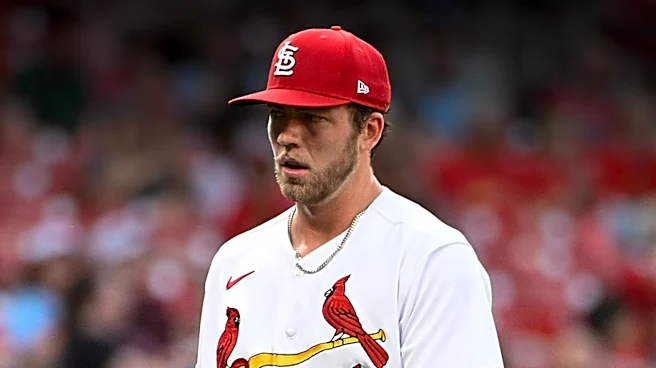





Steven Norman Carlton, a left-handed pitcher, began his Major League Baseball career with the St. Louis Cardinals in 1965. Debuting as a 20-year-old, Carlton quickly established himself as an imposing and dominant force on the mound. Standing 6 feet 4 inches tall, he was known for his hard fastball and slider, which made him an intimidating presence for opposing batters. His early years with the Cardinals were marked by immediate success, including
winning records and significant postseason appearances, setting the stage for a legendary career.
Rising Through the Ranks and World Series Appearances
By 1967, Carlton had secured a regular spot in the Cardinals' starting rotation. That year, he posted a 14–9 record with a 2.98 ERA in 28 starts, contributing to the team's journey to the World Series. In the 1967 World Series, Carlton started Game 5 against the Boston Red Sox, pitching six strong innings and allowing only an unearned run, though he took a 3–1 loss. Despite this, the Cardinals ultimately triumphed over the Red Sox to capture the World Series title.
The following season, 1968, Carlton continued his strong performance with a 13–11 record and a 2.99 ERA. The Cardinals once again reached the World Series, though they ultimately lost to the Detroit Tigers in seven games. Carlton pitched in two relief appearances during the 1968 series, giving up three runs over four innings. His consistent performance in these early years showcased his potential as a top-tier pitcher in the league.
A Record-Setting Strikeout Performance
Carlton's individual brilliance was particularly evident on September 15, 1969. In a game against the New York Mets, he struck out an astonishing 19 batters, setting what was then the modern-day record for strikeouts in a nine-inning game. Despite this historic performance, the Cardinals lost the game to the Mets by a score of 4–3. This remarkable feat underscored his ability to dominate hitters with his powerful arsenal.
He concluded the 1969 season with an impressive 17–11 record, a 2.17 ERA—which was the second-lowest in the National League—and 210 strikeouts. These statistics highlighted his growing reputation as one of the league's premier pitchers. His consistent ability to record high strikeout numbers and maintain a low earned run average made him a formidable opponent for any team.
Contract Disputes and Departure from St. Louis
Despite his on-field success, Carlton's tenure with the Cardinals was not without its challenges, particularly regarding contract negotiations. A significant salary dispute arose in 1970, when he held out for $50,000 after making $26,000 the previous year, while the Cardinals offered $31,000. This disagreement led to him being a no-show at spring training that year, and he subsequently went 10–19 with a 3.73 ERA, leading the National League in losses.
He rebounded strongly in 1971, achieving his first of six 20-win seasons with a 20–9 record and a 3.56 ERA. However, another salary dispute following this successful season led to his trade. Cardinals owner Gussie Busch ordered Carlton to be traded after he sought $10,000 more than the team's $55,000 offer. On February 26, 1972, Carlton was traded to the Philadelphia Phillies for pitcher Rick Wise, marking the end of his impactful, though sometimes contentious, time with the St. Louis Cardinals. Over parts of seven seasons with the Cardinals, Carlton compiled a 77–62 record with a 3.10 ERA in 190 games and 172 starts, including 66 complete games and 16 shutouts. He was also selected to the NL All-Star team in 1968, 1969, and 1971.