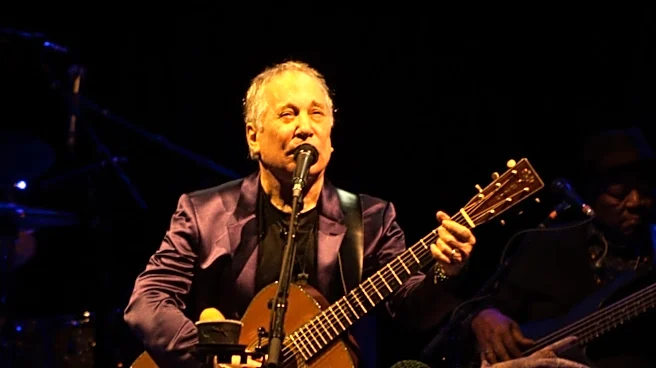

Paul Simon's seventh solo studio album, *Graceland*, released on August 25, 1986, marked a significant turning point in his career, blending diverse musical styles and earning widespread critical acclaim.
The album, produced by Simon himself and engineered by Roy Halee, incorporated pop, rock, a cappella, zydeco, and South African genres like isicathamiya and mbaqanga. This ambitious project emerged during a period when Simon's career in the 1980s was reportedly struggling, making *Graceland* a pivotal work that revitalized his artistic trajectory and introduced new sounds to a global audience.
The Genesis of a Global Sound
The inspiration for *Graceland* began with the song "Gumboots" by the Boyoyo Boys. Simon wrote lyrics for this instrumental piece and re-recorded it, eventually making it the fourth track on the album. This initial step set the stage for a broader exploration of African music. Simon traveled to South Africa to record parts of the album, a decision that would later draw both praise and controversy. During his time there, he collaborated extensively with black artists from South Africa and Lesotho, including the renowned group Ladysmith Black Mambazo and guitarist Ray Phiri from the group Stimela. These collaborations were instrumental in shaping the album's distinctive sound and brought these African musicians to a wider audience in North America and Europe.
Beyond the African continent, *Graceland* also featured contributions from established musicians in North America and Europe. Artists such as The Everly Brothers, Linda Ronstadt, and Los Lobos participated in the recording sessions, further enriching the album's eclectic mix. The recording process spanned from October 1985 to June 1986, taking place in various studios across the globe, including Abbey Road in London, Amigo Studios in Los Angeles, The Hit Factory in New York City, Master-Trak Enterprises in Crowley, Louisiana, and Ovation Studios in Johannesburg. This international approach to recording underscored the album's global ambition and its fusion of diverse musical traditions.
Lyrical Craft and Personal Reflection
Simon's lyrical process for *Graceland* involved listening to the recordings made in Johannesburg and identifying musical patterns to fit his verses. He noted the challenge of this, as African rhythms often shifted subtly, and melodies were frequently dictated by the bassline rather than the guitar. He observed that harmonically, African music primarily used three major chords, contributing to its often joyful sound, which allowed him considerable freedom in crafting melodies within a major scale. Simon improvised by creating falsetto melodies and singing any words that came to mind in his lower and mid-range.
In contrast to his earlier work, *Hearts and Bones*, *Graceland*'s subject matter was generally more upbeat. Simon aimed for simplicity in his writing without compromising the language. He found that composing more personal songs took significantly longer due to what he described as "a lot of avoidance going on," often requiring rewrites to simplify overcomplicated words. Songs like the title track "Graceland" and "The Boy in the Bubble" took three to four months to complete, while others, such as "All Around the World" and "Crazy Love," came together more quickly. The song "The Boy in the Bubble" notably discusses themes of starvation and terrorism, yet it interweaves these with wit and optimism, reflecting Simon's view of the world as a balance between "hope and dread," ultimately leaning towards hope.
The Iconic Title Track and Its Inspirations
The title track, "Graceland," and the album's name itself were not initially inspired directly by Elvis Presley's estate. Simon recounted in documentaries like *Classic Albums: Graceland* and *Under African Skies* that he sang "Graceland, Memphis Tennessee" because it fit rhythmically with the music, lacking an immediate lyrical direction. It was only later that he decided not to change the lyrics, which prompted him to visit the actual Graceland, a place he had not seen before. This journey to Memphis further inspired him, leading to additional lyrical passages, including the opening line, "The Mississippi Delta was shining like a National Guitar."
The song "Graceland" also features vocals by The Everly Brothers. Lyrically, it follows the singer's thoughts during a road trip to Graceland after the failure of his marriage. Simon's ex-wife, actress and author Carrie Fisher, confirmed that certain lines in the song, such as "She's come back to tell me she's gone / As if I didn't know that, as if I didn't know my own bed / As if I'd never noticed the way she brushed her hair from her forehead," referred to her. Fisher acknowledged her habit of brushing her hair from her forehead and expressed feeling privileged to be featured in one of Simon's songs. Simon remained unsure of the album's overarching thematic connection throughout its creation, using numerous legal pads to combine random words and phrases. He ultimately derived the album title from changing "driving through Wasteland" to "going to Graceland," viewing it as a spiritual journey to the home of a rock forefather to rekindle his love for music, mirroring his physical journey to Africa for musical inspiration.