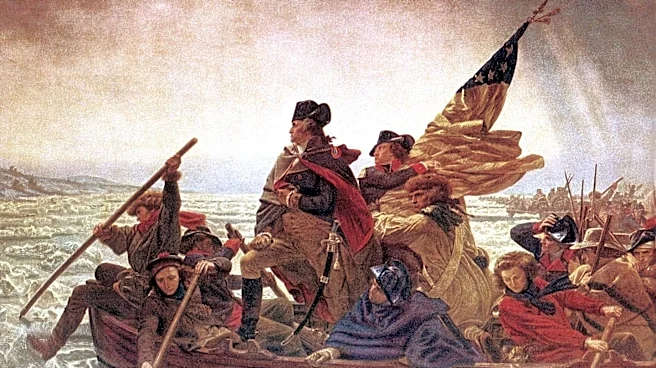






The Battle of White Plains, fought on October 28, 1776, near White Plains, New York, was a significant engagement during the American Revolutionary War. It formed a crucial part of the New York and New Jersey campaign, following General George Washington's Continental Army's retreat northward from New York City. British General William Howe's objective was to cut off Washington's escape route, leading to a series of maneuvers and ultimately this confrontation.
The battle itself, while not a decisive victory for either side, highlighted the strategic challenges faced by the Continental Army and the persistent pursuit by British forces.
Washington's Strategic Retreat and Defensive Posture
After being alerted to General Howe's landing of troops in Westchester County, Washington made the critical decision to retreat further. He established a defensive position in the village of White Plains. However, a key oversight in this defensive strategy was the failure to secure firm control over the local high ground, a factor that would prove disadvantageous during the battle. This period of retreat and regrouping was essential for the survival of the Continental Army, as it sought to avoid being trapped and destroyed by the superior British forces.
Washington's preparations included sending Colonel Rufus Putnam on a reconnaissance mission on October 20 to assess the British troop movements. Upon receiving Putnam's report, Washington immediately ordered William Alexander's troops, stationed further north, to march to White Plains. These troops arrived on October 21, followed by other regiments throughout the day. Washington decided to move most of his forces to White Plains, leaving a garrison of 1,200 men under Nathanael Greene to defend Fort Washington in Manhattan.
The British Advance and Initial Skirmishes
General Howe's army advanced slowly, with his central and right-wing troops following the road from New Rochelle to White Plains. A Loyalist regiment occupied Mamaroneck, which was attacked by a detachment of Lord Stirling's forces led by John Haslet. This attack resulted in the capture of over thirty British soldiers and provisions, though at the cost of several American casualties. In response, Howe sent soldiers from his right wing to occupy Mamaroneck. On October 22, Howe received significant reinforcements of 8,000 troops led by Wilhelm von Knyphausen, who landed at New Rochelle.
Washington established his headquarters at the Elijah Miller House in North White Plains on October 23. He fortified a defensive position by digging two lines of trenches on high ground, protected on the right by a swamp near the Bronx River and overlooked by higher hills to the rear, which could serve as a retreat path. The American defenses stretched for three miles, with Chatterton's Hill, a height overlooking the plain where the British would advance, held by several hundred militiamen, including those from Massachusetts under John Brooks.
The Battle on Chatterton's Hill
On the morning of October 28, as Washington inspected the terrain, he received news of the British advance. He dispatched 1,500 men under Joseph Spencer to slow the British army and sent Haslet's 1st Delaware Regiment and Alexander McDougall's brigade (comprising the 3rd New York, Connecticut, Maryland, and McDougall's own regiments) as reinforcements to Chatterton's Hill. Spencer's forces crossed the Bronx River, took cover behind a stone wall, and exchanged fire with Hessian troops led by Johann Rall, who formed the vanguard of the British left column. These American companies were eventually forced to retreat across the Bronx River when Clinton's column threatened their flank, with covering fire from troops on Chatterton's Hill.
Rall's troops attempted to take the hill but were repelled by Haslet's soldiers and militiamen, retreating to a nearby hill on the same side of the river. This coordinated defense temporarily halted the entire British army. While Howe and his staff deliberated, Hessian artillery opened fire on the hill, causing some American militiamen to retreat in panic. McDougall's arrival and his brigade helped rally the troops, establishing a defensive line with militiamen on the right and Continentals along the summit. Howe then ordered a detachment of British and Hessian troops to take the hill. Rall was to charge the American right, a Hessian battalion under Donop would attack the center, and a British column under General Leslie would attack the right. The American line was eventually forced to retreat northward, covered by Haslet's Delaware regiment, which was the last to leave the hill. The fighting was intense, with both sides suffering casualties before the Continentals made an orderly retreat.