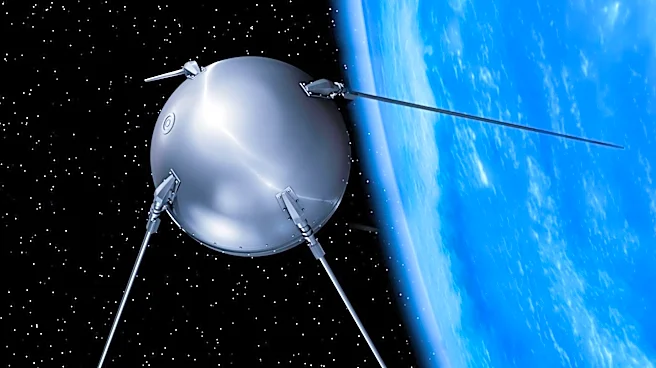





The National Aeronautics and Space Administration (NASA) was officially established on July 29, 1958, marking a pivotal moment in American history and the global space race. Its creation was a direct response to the Soviet Union's launch of Sputnik 1 in October 1957, an event that sent shockwaves through the United States and highlighted a perceived lag in technological advancement. This urgent need to regain leadership in space and aeronautics spurred
the U.S. Congress and President Dwight D. Eisenhower to take decisive action, transforming an existing aeronautical research committee into a comprehensive civilian space agency.
The Pre-NASA Landscape: NACA's Legacy
NASA's roots are deeply embedded in the National Advisory Committee for Aeronautics (NACA), an organization that had been at the forefront of American aviation research for over four decades. Established in 1915, NACA's initial purpose was to foster aeronautical research and development, as the United States recognized it was significantly behind Europe in aviation capability by 1914. Over the years, NACA conducted crucial aeronautical research supporting the U.S. Air Force, Army, Navy, and the civil aviation sector. Following World War II, NACA's interests expanded to include guided missiles and supersonic aircraft, leading to joint programs like the development and testing of the Bell X-1 with the U.S. Air Force. The committee's rocketry program at the Pilotless Aircraft Research Division further fueled its growing interest in space exploration.
The Sputnik Catalyst and America's Response
The launch of Sputnik 1 by the Soviet Union on October 4, 1957, dramatically accelerated the timeline for a dedicated U.S. space agency. This event, ushering in the Space Age, exposed a critical gap in American space capabilities. While NACA had an early rocketry program, the initial responsibility for launching the first American satellite fell to the Naval Research Laboratory's Project Vanguard. However, Vanguard experienced operational issues, leading the Army Ballistic Missile Agency to successfully launch Explorer 1, America's first satellite, on February 1, 1958. The Eisenhower Administration, recognizing the need for a clear distinction between military and civil space endeavors, decided to separate these programs, which had previously been organized under the Department of Defense's Advanced Research Projects Agency.
Forging a New Agency: The National Aeronautics and Space Act
In the wake of the "Sputnik crisis," the U.S. Congress urged immediate action to address the perceived threat to national security and technological leadership. President Eisenhower, while advocating for more deliberate measures, ultimately agreed that a new federal agency, building upon NACA's foundation, was necessary to manage all non-military space activities. On January 12, 1958, NACA organized a "Special Committee on Space Technology" to study the concept of a new non-military space agency. This committee included consultation from the Army Ballistic Missile Agency's large booster program, led by Wernher von Braun, a German scientist who had developed ballistic missiles like the V-2 rocket during World War II before coming to the U.S.
On July 29, 1958, President Eisenhower signed the National Aeronautics and Space Act, officially establishing NASA. The agency began operations on October 1, 1958. This act abolished NACA, transferring its 8,000 employees, an annual budget of $100 million, three major research laboratories (Langley Aeronautical Laboratory, Ames Aeronautical Laboratory, and Lewis Flight Propulsion Laboratory), and two small test facilities directly to NASA. Additionally, elements of the Army Ballistic Missile Agency, including von Braun's team, and the Naval Research Laboratory's Project Vanguard were incorporated into the new agency. NASA also gained control of the Jet Propulsion Laboratory in December 1958. This comprehensive integration firmly established NASA as the United States' civil space leader, while the Air Force maintained military space leadership, setting the stage for America's ambitious journey into space.