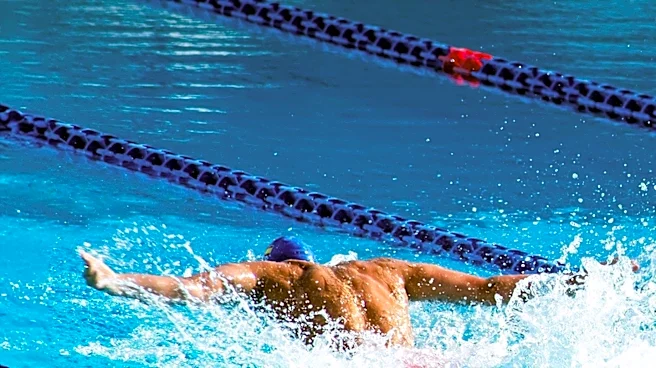




Ryan Steven Lochte's journey to becoming a 12-time Olympic medalist and world record holder was not a straightforward one, marked by an initial reluctance towards the sport that would eventually define his career. Born on August 3, 1984, in Rochester, New York, Lochte was introduced to swimming at a young age, beginning at eight years old. With both of his parents serving as swimming coaches, the aquatic environment was a natural part of his upbringing.
However, his early engagement with swimming was far from serious, a period characterized more by playful distraction than dedicated training.
His father once humorously remarked that he would send Ryan to shower when he was messing around, noting that his son spent more time in the showers than he did in the pool. This casual approach persisted through much of his early years. It wasn't until his junior high school years that Lochte began to take swimming seriously, a shift catalyzed by a pivotal moment of personal frustration. This transformation from a somewhat indifferent participant to a fiercely determined competitor is a key aspect of his athletic development.
The Turning Point and Dedication to the Sport
The significant turning point in Ryan Lochte's swimming career occurred when he was 14 years old. A loss at the Junior Olympics ignited a profound change in his attitude and approach to the sport. Reflecting on that experience, Lochte later commented, "I suddenly said, 'I'm sick of losing'. After that I trained hard and I never lost there again." This moment of self-realization and resolve marked the beginning of his dedicated pursuit of excellence in swimming. From that point forward, his training intensified, and his focus sharpened, setting him on a trajectory toward becoming one of the sport's most accomplished athletes.
His commitment led him to train at the Daytona Beach Speed Swimming section at the University of Florida, where he honed his skills and developed into a versatile swimmer. Lochte specialized in multiple strokes, including backstroke, freestyle, individual medley, and butterfly. This broad skill set allowed him to compete and excel in a wide array of events, distinguishing him from many of his peers who often focused on one or two primary strokes. His ability to master different swimming styles became a hallmark of his competitive strategy and contributed significantly to his success.
Ascending to World-Class Status
Lochte's dedication and versatility quickly translated into international success. His ascent to world-class status was evident in his early record-breaking performances. At the 2006 FINA Short Course World Championships in Shanghai, held just two weeks after the NCAA Championships, Lochte made a significant impact. He secured three individual titles, along with a silver and a bronze medal. During this event, he set new world records in both the 200-meter individual medley and the 200-meter backstroke. Furthermore, he achieved another world record in the 100-meter backstroke, becoming the first man to complete the distance in under 50 seconds, a feat he accomplished in the opening leg of the 4x100-meter medley relay. He also won his third gold medal in the 400-meter individual medley, setting a new championship record.
The following year, at the 2007 World Aquatics Championships in Melbourne, Australia, Lochte continued to break barriers. He won his first individual gold medal at a long course world championships in the 200-meter backstroke, famously defeating compatriot Aaron Peirsol and breaking Peirsol's world record and his seven-year win streak in the event. This marked Lochte's first world record in a long course event. Shortly after, he contributed to another world record in the 4x200-meter freestyle relay alongside Michael Phelps, Klete Keller, and Peter Vanderkaay. He also earned silver medals in the 100-meter backstroke, and both the 200-meter and 400-meter individual medley, making his medal total for the meet second only to Phelps. These early international successes underscored his transformation from a reluctant swimmer to a dominant force, capable of challenging and surpassing the sport's established legends. His consistent performance and ability to set new benchmarks in various events solidified his reputation as a truly exceptional athlete.