









While famously known for transporting the Pilgrims to the New World in 1620, the Mayflower had a history as a working merchant vessel both before and after its iconic voyage. The name "Mayflower" was surprisingly common, with 26 vessels bearing it in English port books during the reign of King James I (1603–1625). The specific identity of Captain Christopher Jones's Mayflower is determined by records from its home port, its estimated tonnage of 180–200
tons, and the master's name. Although its exact construction date and location are unknown, later records indicate it was "of London," and port books from 1609–1611 designated it "of Harwich," coincidentally Jones's birthplace around 1570.
Early Career as a Merchant Ship
Records from August 1609 show Jones as both master and part owner of the Mayflower when it was chartered for a voyage from London to Trondheim, Norway, and back. During its return, the ship lost an anchor in bad weather and delivered a short cargo of herring, leading to litigation that remained unresolved until at least 1612. The Mayflower was documented on the Thames in London twice in 1613, in July and again in October and November. In 1616, it carried a cargo of wine on the Thames, suggesting a recent voyage to a wine-producing region such as France, Spain, Portugal, or the Canary Islands.
Captain Jones regularly sailed the Mayflower across the English Channel, transporting English woolens to France and bringing French wine back to London. His voyages also included carrying goods like hats, hemp, Spanish salt, hops, and vinegar to Norway. It is also possible that he took the Mayflower whaling in the North Atlantic off Spitsbergen or sailed to Mediterranean ports. There is a gap in records for Jones's Mayflower between 1616 and 1624, which is unusual for a ship regularly trading in and out of London. The absence of admiralty court documents mentioning the Pilgrim voyage of 1620 might be due to lost records or the unique arrangements made for the Pilgrims' transfer from Leyden to New England.
Design, Layout, and Armament
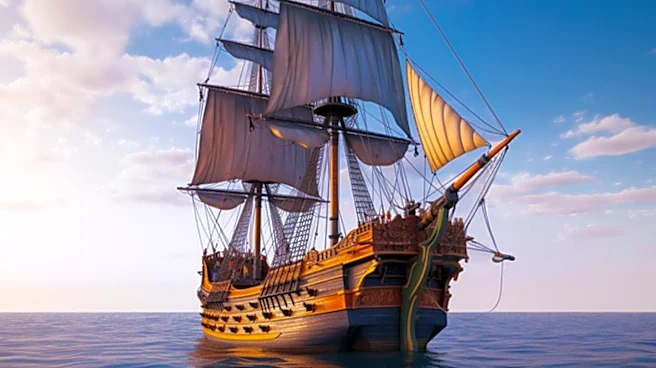
The Mayflower was a square-rigged vessel featuring a beakhead bow and high, castle-like structures at its fore and aft, designed to protect the crew and main deck from the elements. This design was typical for English merchant ships of the early 17th century. Its stern boasted a 30-foot-high, square aft-castle, which, while protective, made it difficult for the ship to sail close to the wind. This characteristic was particularly problematic in the North Atlantic's prevailing westerlies, especially during the fall and winter of 1620, contributing to the more than two-month duration of the voyage to America. In contrast, the return trip to London in April–May 1621 took less than half that time, benefiting from favorable winds.
While the Mayflower's exact dimensions are unknown, it likely measured about 100 feet from its prow to the tip of its stern superstructure, with a width of approximately 25 feet and a keel about 12 feet below the waterline. William Bradford estimated its cargo capacity at 180 tons, and records suggest it could carry 180 casks, each holding hundreds of gallons. The ship featured three masts—mizzen, main, and fore—along with a spritsail in the bow area. It had three primary levels: the main deck, gun deck, and cargo hold. Captain Jones's cabin was located aft on the main deck, measuring about ten by seven feet. The steerage room, forward of the cabin, likely housed officers' berths and contained the ship's compass and whipstaff for steering. The capstan, used for controlling ropes, was further forward on the main deck, while the forecastle, near the bow, served as the cook's area and possibly sleeping quarters for sailors.
The gun deck, measuring about 50 by 25 feet with a five-foot ceiling, served as the passengers' living space during the voyage. This area was equipped with gun ports for cannons, making it a dangerous place during conflict. The gun room, in the stern, stored gunpowder and ammunition, and may have housed stern chasers, small cannons for firing from the ship's rear. A windlass in the bow area of the gun deck was used to raise and lower the main anchor. Passengers accessed the main deck via wooden or rope ladders, as there were no stairs. Below the gun deck was the cargo hold, where passengers stored food, supplies, clothing, bedding, personal weapons, and tools for settlement. The Mayflower was heavily armed, carrying a brass minion cannon weighing about 1,200 pounds, a saker cannon of about 800 pounds, and two base cannons. It had at least ten pieces of ordnance on its gun deck, with four pieces later unloaded to fortify Plymouth Colony.
Later History and Legacy
By 1620, Captain Jones was one of the ship's owners, along with Christopher Nichols, Robert Child, and Thomas Short. Thomas Weston, a member of the Company of Merchant Adventurers of London, chartered the Mayflower from Child and Short for the Pilgrim voyage. After Captain Jones's death in 1622, three of the Mayflower's owners, including Jones's widow Josian, applied to the admiralty court for an appraisal of the ship on May 4, 1624. This appraisal, likely to settle the captain's estate, was conducted by four mariners and shipwrights in Rotherhithe, London, where the Mayflower was stationed. The appraisal documents provide details on the ship's gear and equipment, including muskets and other arms. The ship, possibly confined to port after Jones's death, was valued at 128 pounds, eight shillings, and fourpence.
The final disposition of the Mayflower remains uncertain. Historian Charles Edward Banks suggests it was disassembled. Historical records indicate that in 1624, Thomas Russell of Jordans, Buckinghamshire, built a barn using timbers purchased from a shipbreaker's yard in Rotherhithe, which many believe came from the Mayflower. This structure, known as the Mayflower Barn, still exists within the grounds of Old Jordan in South Buckinghamshire. While it became a tourist attraction, it is now privately owned and closed to the public. It is important to note that another ship named Mayflower made several voyages to Plymouth Colony, including in 1629 with 35 passengers, many from the original Pilgrim congregation in Leiden, and as part of the Winthrop Fleet in 1630, 1633, 1634, and 1639. This second Mayflower was lost at sea in October 1641 while carrying 140 passengers to Virginia.