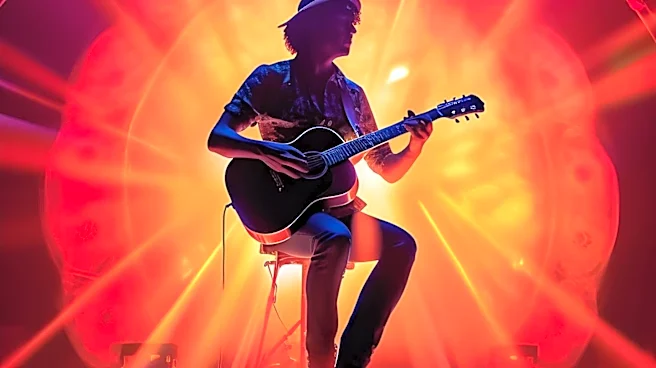




Samuel Robert Gibson, a prominent figure in the American folk music revival, left an indelible mark on the musical landscape through his versatile artistry and influential collaborations. Born in Brooklyn, New York, on November 16, 1931, Gibson's musical journey began with a strong vocal interest, eventually leading him to master the banjo and 12-string guitar. His career, spanning decades, showcased not only his talent as a performer but also his significant
contributions as a songwriter and his adaptability across various artistic mediums, even in the face of personal challenges.
A Multi-Instrumentalist's Impact on Folk Music
Gibson's early life saw him exploring different communities outside New York City before a pivotal encounter with Pete Seeger in 1953. Inspired by Seeger's music, Gibson acquired a banjo and dedicated himself to learning the instrument and studying folk music. This commitment quickly led to a performing career, starting at age 22 in diverse venues across New York, Miami, Cleveland, and even on Caribbean cruise ships. His principal instruments, the banjo and 12-string guitar, became synonymous with his sound and were central to his role in the folk revival.
His influence was particularly felt in the Chicago folk scene, where he performed for eleven months at the Gate of Horn, a club opened by Albert Grossman. Gibson's performances, initially as an opener and later as a headliner, helped shape the club's reputation. He was instrumental in bringing Joan Baez to national attention, introducing her at the 1959 Newport Folk Festival. The 1961 album "Gibson and Camp at the Gate of Horn," a collaboration with Hamilton Camp, further solidified his impact, influencing artists like John Lennon, Gordon Lightfoot, and John Denver.
Collaborations and Artistic Evolution
Gibson's collaborative spirit extended beyond his work with Hamilton Camp. He and Camp were regular performers at New York City's Village Gate. Although they declined Art D'Lugoff's suggestion to add a female voice to their duo, this idea was later presented to Peter Yarrow and Paul Stookey, leading to the formation of Peter, Paul and Mary, a group deeply influenced by Gibson's musical style. Peter Yarrow himself acknowledged this, stating, "When you listen to PPM, you are hearing Bob Gibson."
Another significant partnership was with cartoonist Shel Silverstein. Their collaboration blossomed after Silverstein completed lyrics for an unfinished Gibson tune, leading to a close friendship and the co-writing of over 200 songs. Their final project, the 1993 album "Makin' A Mess," produced by Silverstein, showcased their enduring creative bond. Despite a career interrupted by addiction to drugs and alcohol, Gibson made an attempt at a comeback in 1978. Although the musical scene had shifted, and his traditional folk style was less favored by younger audiences, he continued his artistic career, engaging in albums, musicals, plays, and television performances, demonstrating his versatility and commitment to his craft until his death in 1996 from progressive supranuclear palsy.