
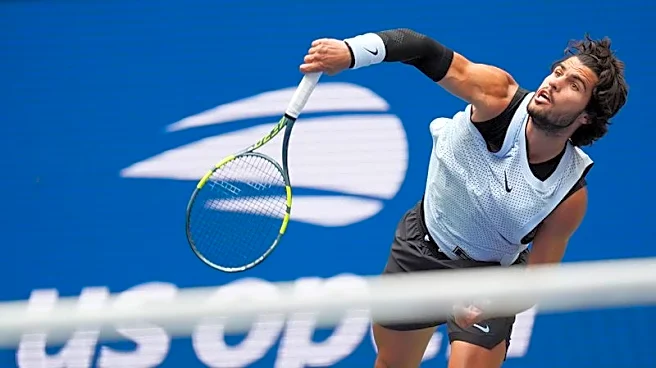
Pete Sampras, a name synonymous with tennis greatness, concluded his illustrious career with a remarkable victory at the 2002 US Open. This triumph marked his 14th and final major title, solidifying his place in the sport's history. His retirement, officially declared in 2003, came after a career spanning from 1988, during which he amassed 64 singles titles and held the world No. 1 ranking for a record six consecutive seasons. Sampras's journey from a young
prodigy to a dominant force on the court is a testament to his skill, determination, and the serve-and-volley style that earned him the nickname "Pistol Pete."
The Climactic 2002 US Open Victory
The 2002 US Open final was a fitting end to Sampras's competitive career, as he faced his long-time rival and compatriot, Andre Agassi. This match was not only a battle for the championship but also the 34th and final encounter between these two tennis legends. Sampras emerged victorious with a score of 6–3, 6–4, 5–7, 6–4, securing his fifth US Open title, an Open Era record. This win extended his all-time record for major titles to 14, a significant milestone in men's tennis. The final was a rematch of their 1990 and 1995 US Open finals, where Sampras had also claimed his first and seventh major titles, respectively. His victory in 2002 meant he ended their head-to-head record at 20–14 in his favor.
This final appearance was Sampras's last professional match, though his official retirement announcement came in 2003. He holds the unique distinction in the Open Era of being the only man to win the final Grand Slam he played. This achievement underscored his ability to perform at the highest level even as his career drew to a close, especially after a period of declining form at the turn of the century.
A Career Defined by Records and Consistency
Sampras's career was characterized by an impressive array of records and consistent top-tier performance. He turned professional in 1988 and quickly made his mark, becoming the youngest male singles champion at the 1990 US Open at just 19 years and 28 days old. He went on to win his first Wimbledon title in 1993 and would dominate the grass-court major, winning it seven times in an eight-year span. His dominance extended beyond individual tournaments, as he finished each year as the world No. 1 for a record six consecutive seasons, a feat that speaks volumes about his sustained excellence.
Throughout his career, Sampras played in 265 official tournaments, securing 64 singles titles. His Grand Slam record is particularly outstanding, with 14 singles titles from 18 finals, giving him an unsurpassed win-loss record of 78% in major finals for players with at least 10 appearances. He is also the only American male player to win more than 10 major titles. His serve, often described as one of the best in the sport's history, was a cornerstone of his game, contributing to his serve-and-volley style. He even set an ATP Tour record in 1993 by becoming the first player to serve over 1,000 aces in a single season.
Navigating Challenges and Maintaining Excellence
While Sampras's career was marked by numerous successes, he also faced challenges. The turn of the century saw a decline in his form, and in 2001, he experienced a season without a single title for the first time in 12 years, finishing the year ranked No. 10, his lowest since 1989. During this period, his 31-match Wimbledon win streak was broken by a 19-year-old Roger Federer in the fourth round, their only official professional match. He also lost in the US Open final to Lleyton Hewitt in straight sets that year.
Despite these setbacks, Sampras demonstrated resilience. His victory at the 2002 US Open was a powerful comeback, proving he still possessed the championship caliber that defined his career. His official retirement in August 2003, at the age of 31, marked the end of an era for professional tennis. Sampras's induction into the International Tennis Hall of Fame in 2007 further cemented his legacy as one of the greatest tennis players of all time, a player who consistently delivered under pressure and set new benchmarks for excellence in the sport.