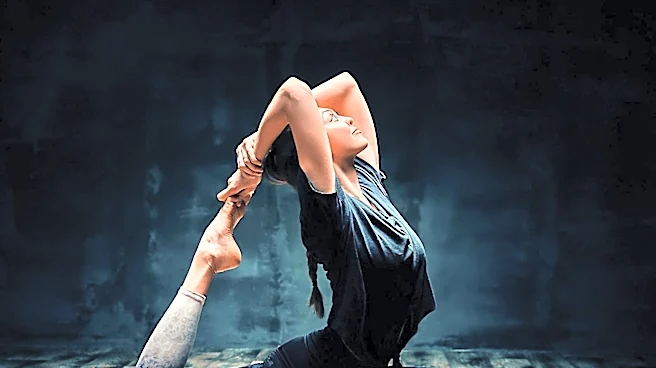
Kapotasana, widely recognized today as Pigeon Pose in modern yoga, carries a history that spans different eras of yoga practice and documentation. The name itself, derived from the Sanskrit words "kapota"
(pigeon) and "asana" (posture or seat), suggests an ancient origin. However, the specific form of the pose known today has evolved, with its modern description appearing in 20th-century yoga texts. This evolution highlights how certain asanas have been reinterpreted or formalized over time, adapting to contemporary yoga methodologies.
Early Mentions and Distinctions
Interestingly, the name Kapotasana was not exclusively applied to the kneeling backbend we know today. Historical records indicate that a different standing posture was also given the name Kapotasana in the 19th-century text, "Shritattvanidhi." This distinction is crucial for understanding the historical development of yoga asanas, as it shows that names could be applied to different poses across various traditions or periods. The modern form of Kapotasana, with its characteristic deep backbend, gained prominence and detailed description in the 20th century, notably in influential works like "Light on Yoga."
20th-Century Formalization and Influence
The 20th century marked a significant period for the formalization and popularization of many yoga asanas, including Kapotasana. Its detailed description in texts from this era helped solidify its place in modern yoga curricula. As an advanced asana, it became a benchmark for flexibility and strength, particularly within traditions such as Ashtanga yoga. The emphasis on specific alignment and the deep backbend required for Kapotasana reflect the systematic approach to asana practice that characterized much of 20th-century yoga development.
Kapotasana in the Context of Advanced Asanas
Within the spectrum of yoga asanas, Kapotasana is categorized as an advanced backbend. Its complexity and the flexibility it demands place it alongside other challenging postures like Chakrasana (Wheel Pose). The requirement to bring the head back to touch the floor, while maintaining the shins and forearms on the ground, underscores its advanced nature. This level of difficulty suggests that the pose was likely introduced into more rigorous or specialized yoga practices, contributing to its reputation as a powerful and transformative posture for experienced practitioners.