




The First International Conference of American States, held in Washington, D.C., from January 20 to April 27, 1890, was a landmark event intended to forge closer ties and facilitate trade among nations of the Western Hemisphere. While it ultimately fell short of establishing a comprehensive customs union, the conference achieved significant, though sometimes overlooked, successes and highlighted underlying tensions that characterized inter-American
relations at the time.
The Agenda and Early Discord
With twenty-seven delegates from thirteen countries, the conference had a substantial agenda. Two nations expected to play major roles, Brazil and Mexico, were notably passive. Brazil was undergoing internal political changes as its Empire transitioned to a Republic, while Mexico, under Porfirio Díaz's authoritarian rule, maintained a deferential relationship with the United States. Leadership among the Latin American nations largely fell to the Argentine delegation, known for its high-caliber representatives and its view of U.S.-guided Pan-Americanism as a potential threat to its established relationships with European countries.
Argentine opposition surfaced early, particularly regarding the election of the conference chairman. The U.S. delegation had largely assumed that Secretary of State James G. Blaine, as host, would be elected. However, the Argentines, supported by the Chileans who harbored mistrust due to Blaine's diplomatic involvement in the War of the Pacific, argued that Blaine was technically not a delegate and therefore unqualified. This initial disagreement set a contentious tone for the deliberations.
Arbitration, Conquest, and Commercial Agreements
A significant portion of the conference sessions, from January 20 to April 27, 1890, was dedicated to the issue of arbitration. There was considerable concern, eloquently articulated by the Argentine delegation, that the United States was pursuing what they termed "hegemonic arbitration," implying a dominant role for the U.S. in resolving disputes. Tensions also arose over the question of whether military conquest could legitimately lead to the acquisition of sovereignty after a war. This specific concern was rooted in Chile's expansion at the expense of Peru and Bolivia during the War of the Pacific (1879–81).
Despite these debates, the conference did manage to reach agreements on commercial and trade matters, as well as an arbitration agreement. However, the arbitration agreement was not as robust as the United States had desired and was ultimately never ratified. The commercial agreements, while present, were limited by concerns among some nations that they were too favorable to the United States. This apprehension underscored a broader reluctance to fully embrace U.S. economic leadership without reservations.
A Lasting Legacy: Regular Meetings and a Permanent Secretariat
While the controversies surrounding arbitration, conquest rights, and customs unions often overshadowed other aspects, the conference achieved a perhaps more significant, though less immediately celebrated, outcome: the establishment of regular inter-American meetings and the creation of a permanent secretariat. This foundational achievement laid the groundwork for ongoing cooperation.
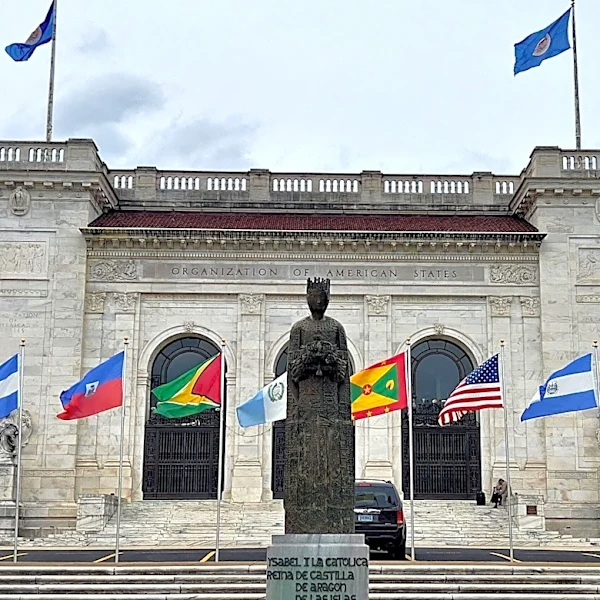
The founding date of this secretariat, originally known as the International Bureau of American Republics, April 14, 1890, is now celebrated as the "Day of the Americas." This Bureau eventually evolved into the Pan American Union and, ultimately, the present-day Organization of American States. Thus, despite the immediate failures to secure a customs union or a strong arbitration treaty, the First International Conference of American States established a crucial institutional framework for future inter-American dialogue and collaboration, proving its long-term impact on hemispheric relations.