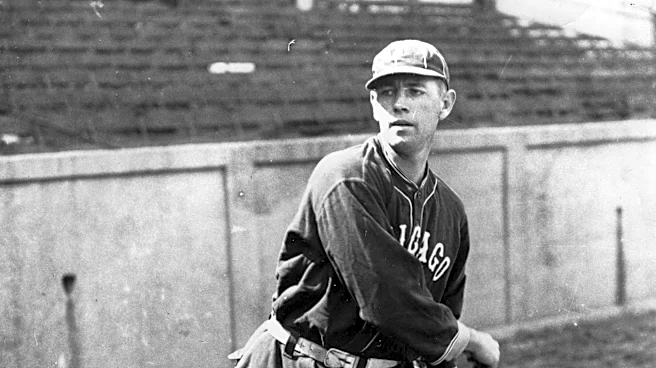



Monte Pearson's baseball career, particularly his impactful years with the New York Yankees, is a testament to his ability to perform at an elite level despite a constant struggle with injuries and health issues. From pleurisy to ankle sprains and chronic arm problems, Pearson repeatedly faced physical setbacks that threatened to derail his career. Yet, time and again, he demonstrated remarkable resilience, delivering some of his most memorable performances,
including a historic no-hitter and crucial World Series victories, even when his body was failing him. His story is one of a pitcher who consistently defied expectations and physical limitations.
Early Challenges and World Series Heroics
Pearson's battle with adversity began almost immediately upon joining the New York Yankees in 1936. Just before the World Series against the New York Giants, he fell ill with pleurisy, a condition that could have easily sidelined him. Despite this serious health issue, Pearson insisted on being included in the pitching rotation. His determination paid off in Game 4, where he delivered a complete game victory, limiting the Giants to just two runs and striking out seven. This performance was not only a display of his pitching prowess but also a clear indication of his mental toughness and commitment to his team, even when physically compromised. He also contributed offensively with two hits, including a double, in the 5–2 win.
The following season, 1937, brought another physical challenge. During spring training, Pearson injured his right ankle after accidentally stepping onto a rolling ball. While he managed to recover in time for the start of the season and pitched solidly, other health problems and a persistent sore arm began to affect him. These ailments significantly limited his playing time, restricting him to just 144 and two-thirds innings pitched across 20 starts and two relief appearances. Despite these limitations, he once again rose to the occasion in the postseason. In Game 3 of the 1937 World Series, facing the New York Giants, Pearson stifled their offense, allowing only a solitary run over eight and two-thirds innings, securing a win that helped the Yankees to their second consecutive World Series title.
The No-Hitter Amidst Control Issues and a "Dead Arm"
The 1938 season showcased Pearson's ability to rebound from physical struggles, though new challenges emerged. While his regular season numbers improved, including a .696 winning percentage and 16 wins, he struggled with control, recording 9 wild pitches and 113 walks. However, the highlight of his season, and a defining moment of his career, came on August 27 when he pitched a no-hitter against his former team, the Cleveland Indians. This remarkable feat was achieved in the second game of a doubleheader, with Pearson pitching on only two days of rest. He struck out seven, allowed just two baserunners via walks, and retired the final 18 batters in a dominant 13–0 victory. This was not only his 13th win of the season and 10th consecutive, but also the first no-hitter at Yankee Stadium, a significant milestone in the venue's history.
Later that year, Pearson faced another severe physical setback: a "dead arm." Doctors discovered a spur on his elbow via X-rays and advised surgery. Yet, with the World Series looming, Pearson once again pushed through the pain. He pitched in Game 3 of the 1938 World Series against the Chicago Cubs, delivering another complete game victory, allowing only two runs (one earned) and striking out nine in a 5–2 win. His ability to overcome such a significant injury to contribute to the Yankees' third straight championship underscored his extraordinary determination and pain tolerance.
The 1939 Masterpiece and Career-Ending Injury
The 1939 season continued Pearson's pattern of battling arm problems. Despite these recurring issues, he maintained a strong winning percentage (.706) in the AL, though his ERA climbed to 4.49. His persistent arm troubles limited him to just 146 and one-third innings pitched and 20 starts, leading to uncertainty about his inclusion in the postseason roster. Manager Joe McCarthy even expressed doubts about Pearson's ability to contribute to the series. However, Pearson once again defied expectations, shrugging off his injury woes to start Game 2 of the 1939 World Series against the Cincinnati Reds.
In what is widely regarded as one of the greatest pitching performances in World Series history, Pearson held the Reds hitless through seven and one-third innings, ultimately allowing only two singles. He struck out eight and walked one in a complete game, 4–0 victory, earning a game score of 90. This masterful performance helped the Yankees sweep the Reds, securing their fourth consecutive championship and giving Pearson the unique distinction of winning a World Series ring in every season he played for the team. Tragically, his resilience finally met its match in 1940 when he tore a shoulder ligament, an injury that prematurely ended his playing career. This final injury, discovered after a full physical examination, forced his trade to the Cincinnati Reds, marking the end of a career defined by both brilliance and an unyielding fight against physical adversity.