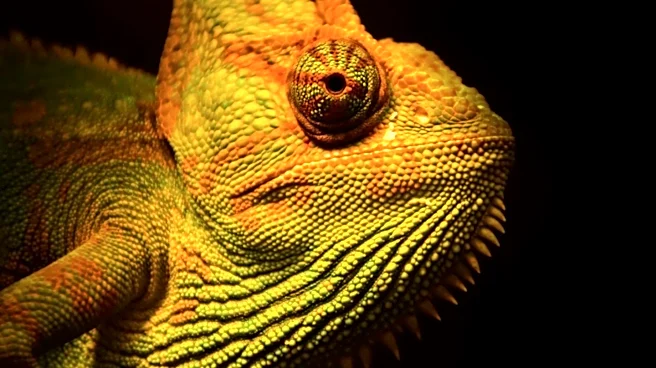








The evolutionary journey of chameleons is a complex narrative, with fossil records providing glimpses into their ancient past and ongoing research shedding light on their remarkable adaptations, such as color change. While nearly half of all modern chameleon species reside in Madagascar, recent studies suggest their origins most likely trace back to mainland Africa, with at least two distinct oceanic migrations occurring from the mainland to Madagascar.
Ancient Ancestors and Geographic Spread
The oldest described chameleon, *Anqingosaurus brevicephalus*, dates back to the Middle Paleocene, approximately 58.7 to 61.7 million years ago, and was discovered in China. Further fossil evidence includes *Chamaeleo caroliquarti* from the Lower Miocene (about 13 to 23 million years ago) found in the Czech Republic and Germany, and *Chamaeleo intermedius* from the Upper Miocene (about 5 to 13 million years ago) in Kenya. These findings indicate that chameleons were once more geographically widespread than they are today, with fossils found across Africa, Europe, and Asia.
Chameleons are believed to be much older than these fossil records suggest, possibly sharing a common ancestor with iguanids and agamids over 100 million years ago, with agamids being more closely related. The diverse speciation observed in chameleons today is theorized to be a direct reflection of the increase in open habitats, such as savannahs, grasslands, and heathlands, that emerged during the Oligocene period. The monophyly of the chameleon family, meaning they all descended from a common ancestor, is supported by several scientific studies.
Debates and Discoveries in Early Chameleon History
In 2016, Daza et al. described a small, likely neonatal lizard preserved in Cretaceous amber from Myanmar, dating to the Albian-Cenomanian boundary. This specimen, measuring only 10.6 mm in snout-vent length, exhibited several traits that led the authors to affiliate it with Chamaeleonidae, including a short and wide skull, large orbits, an elongated and robust lingual process, and an extremely short, curled tail. Their phylogenetic analysis suggested it was a stem-chamaeleonid. However, in 2018, Matsumoto & Evans reinterpreted this specimen as an albanerpetontid amphibian. This specimen was later named *Yaksha perettii* in 2020, and was noted to possess several convergently chameleon-like features, including adaptations for ballistic feeding, despite the reinterpretation of its classification.
The Evolution of Color Change and Signal Efficacy
While the precise evolutionary history of color change in chameleons remains largely unknown, one aspect that has been conclusively studied is the effect of signal efficacy. Signal efficacy refers to how well a signal can be perceived against its background, and it has been shown to correlate directly with the spectral qualities of chameleon displays. Studies on dwarf chameleons, which inhabit diverse environments from forests to grasslands and shrubbery, have revealed that chameleons in brighter areas tend to exhibit brighter signals. Conversely, chameleons in darker habitats tend to display signals with relatively more contrast against their backgrounds.
This finding suggests that signal efficacy, and consequently the habitat, has played a significant role in shaping the evolution of chameleon signaling. Researchers note that selection for signal efficacy appears to be more important than selection for crypsis (camouflage) because chameleon signals are typically displayed only briefly. For most of the time, chameleons maintain muted, cryptic colors to blend into their surroundings, only using their vibrant displays for short, impactful communications.