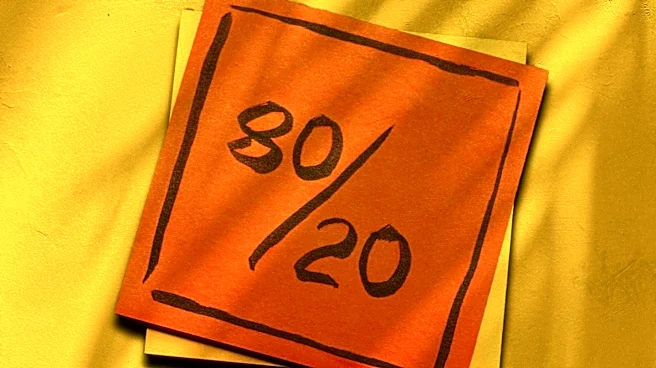









The Pareto Principle, often referred to as the 80/20 rule, is a concept that suggests a small percentage of causes are responsible for a large percentage of effects. This principle has found applications in various fields, from business management to economics. Named after the Italian economist Vilfredo Pareto, the principle highlights the imbalance between inputs and outputs, suggesting that 80% of outcomes often result from 20% of causes.
Origins of the Pareto Principle
The Pareto
Principle traces its roots back to the observations of Vilfredo Pareto, who noted that approximately 80% of the land in Italy was owned by 20% of the population. This observation was documented in his work, "Cours d'économie politique," and laid the groundwork for what would become a widely recognized principle. Pareto's insights were later expanded upon by Joseph M. Juran, a management consultant who applied the principle to quality control and improvement.
Juran's interpretation of the Pareto Principle emphasized the idea of the "vital few and the useful many," suggesting that a small number of causes are often responsible for the majority of problems. This perspective has been instrumental in helping organizations prioritize their efforts and resources effectively.
Applications Across Various Fields
The Pareto Principle is not limited to economics or quality control; it has been applied across numerous fields. In business management, for example, it is often observed that 80% of sales come from 20% of clients. This insight allows companies to focus their marketing and customer service efforts on the most profitable segments of their customer base.
In fundraising, the principle suggests that a small percentage of donors contribute the majority of funds. This understanding helps organizations target their fundraising campaigns more effectively, ensuring that they maximize their efforts and resources. The principle's versatility and applicability make it a valuable tool for decision-making in various contexts.
Mathematical Foundation and Variations
Mathematically, the Pareto Principle is associated with a power law distribution, also known as a Pareto distribution. This distribution is characterized by a small number of causes having a disproportionately large impact on outcomes. The principle is often expressed as an 80/20 rule, but the actual distribution can vary, sometimes appearing as 90/10 or 70/30.
The Pareto Principle is an illustration of a power law relationship, which is also observed in natural phenomena such as bush fires and earthquakes. This relationship highlights the scale-invariant nature of the principle, where the same pattern of imbalance can be observed across different magnitudes and contexts.
Overall, the Pareto Principle provides a framework for understanding the disproportionate relationship between causes and effects. Its applications across various fields demonstrate its utility in helping individuals and organizations prioritize their efforts and resources effectively.