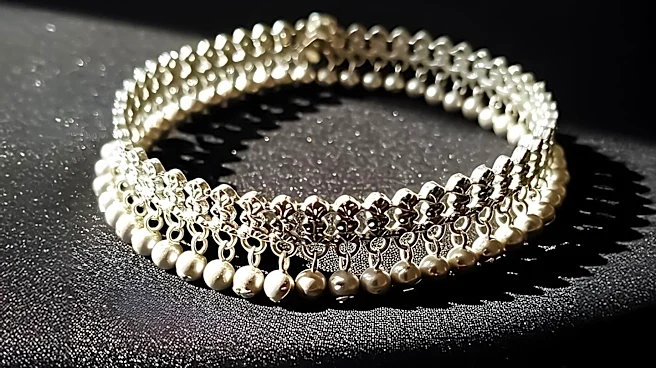







Anklets, also known as ankle chains or ankle bracelets, are more than just decorative items; they have historically served as powerful symbols of social status, cultural tradition, and personal fashion across various societies. From ancient civilizations where their material denoted wealth, to their integral role in traditional ceremonies, and their modern-day use as a style statement, anklets offer a rich tapestry of meaning. Their presence in diverse
cultures underscores their enduring appeal and the varied ways in which human beings use adornment to communicate identity and values.
Markers of Social Standing in Antiquity
In ancient Egypt, anklets were worn by women of all social classes, but the materials used clearly distinguished the wealthy from the less affluent. More expensive metals like gold were common among the rich, while silver and iron were more prevalent among lower social classes. This practice meant that an anklet was not just an ornament but a visible indicator of one's economic standing within society. The craftsmanship also varied, with anklets during the fourth, fifth, and sixth dynasties often made of beads threaded in several rows and held together with spacer-bars, showcasing different levels of artistry and material value.
Similarly, in ancient Greece and Rome, the type of anklet worn denoted social status. Plebeian women, who were common citizens, typically wore silver anklets, while patricians, members of the elite class, adorned themselves with gold. This distinction highlights how jewelry, including anklets, was integrated into the social hierarchy, serving as a non-verbal cue about an individual's position. The consistent use of precious metals to signify wealth and status across these ancient civilizations demonstrates a shared human tendency to express social standing through personal adornment.
Traditional Significance in Indian Culture
In India, anklets are deeply embedded in cultural and traditional practices, particularly in the context of marriages. They are considered an important piece of jewelry, often worn by women along with saris during these significant ceremonies. The eastern Indian state of Odisha, renowned for its traditional jewelry, features specific varieties like Paunji Nupur, and an elaborate type called "padapadma" that covers the entire foot. These regional variations underscore the rich diversity of anklet traditions within India.
Beyond weddings, the choice of metal for anklets in India has also traditionally been linked to caste. Historically, only Kshatriya (royal/warrior caste) persons were permitted to wear gold anklets, while individuals from other castes wore silver. This practice illustrates how anklets were not just decorative but also reinforced social structures and traditional norms. The terms "payal" (payalak) and "jhanjar" in Hindi and Punjabi, and "nupur" in Bengali, further emphasize the integral role of anklets in the linguistic and cultural fabric of the Indian subcontinent and the Bengal region.
Evolution as a Fashion Statement and Modern Interpretations
In the United States, anklets evolved into a fashionable accessory from the 1930s through the late 20th century. Both casual and more formal styles emerged, catering to different tastes and occasions. While younger men and women might opt for casual leather anklets, formal versions made of silver, gold, or beads are predominantly worn by women as fashion jewelry. This shift reflects a broader trend where traditional ornaments are reinterpreted and adopted into contemporary fashion, often losing some of their original symbolic weight but gaining new aesthetic value.
An interesting, though less common, practice involves joining anklets on both ankles with a chain to limit the step. This was historically prevalent in Southeast Asia, where it was intended to create a "feminine" short tripping step. Today, a few Western women adopt this practice, though it is rarely seen in public. Even more rarely, some individuals choose to wear "permanent" soldered ankle chains, sometimes with connecting chains, pushing the boundaries of personal expression and body adornment. These modern interpretations highlight the versatility of the anklet, allowing it to transcend its historical and cultural origins to become a canvas for individual style and statement.