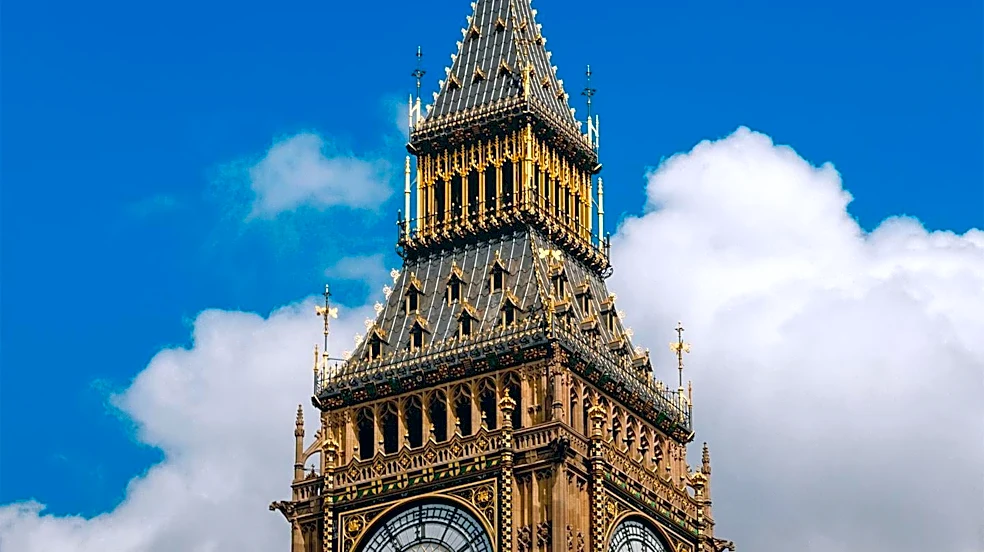










Big Ben, the iconic nickname for the Great Bell of the Great Clock of Westminster, and by extension, the clock tower itself, stands as a powerful cultural symbol of the United Kingdom. Located at the north end of the Palace of Westminster in London, England, this landmark is instantly recognizable worldwide. Its image is frequently used in visual media to signify a generic location in Britain, often accompanied by classic red double-decker buses or black
cabs. Beyond its visual presence, the sound of its chimes, known as the Westminster Quarters, has become equally emblematic, preferred as the original and most authentic sound of British timekeeping.
The tower, officially renamed the Elizabeth Tower in 2012 to commemorate the Diamond Jubilee of Queen Elizabeth II, was originally known simply as the Clock Tower. Its construction was part of Charles Barry's design for a new Palace of Westminster after a devastating fire in 1834. Augustus Pugin, known for his Gothic Revival style, designed the Clock Tower, drawing inspiration from earlier works. The tower's enduring presence, even through significant historical events like the Second World War, has solidified its place in the national consciousness.
A Landmark Through Time and Conflict
Big Ben's resilience is a testament to its robust construction and symbolic importance. During the Blitz in the Second World War, specifically on May 10, 1941, an air raid by the Luftwaffe damaged two of the clock's dials and parts of the tower's stepped roof. Despite this, the clock mechanism continued to run accurately and chimed throughout the entire period of the Blitz. This steadfastness during a time of national crisis further cemented its status as a symbol of British endurance and continuity. The damage to the Commons chamber, which was destroyed in the same raid, led to the design of a new five-floor block, with the current chamber being used for the first time in 1950.
The tower's foundations rest on a layer of gravel over London Clay, which has caused it to lean slightly to the north-west. This lean, approximately 230 mm over 55 meters in height, gives it an inclination of about 1/240. Experts believe this leaning will not pose a problem for another 4,000 to 10,000 years. Efforts to stabilize the tower were undertaken in the 1990s, with thousands of tons of concrete pumped into the ground during the construction of the Jubilee Line Extension of the London Underground, which contributed a planned maximum of 22 mm increased tilt.
The Voice of the Nation: Chimes and Celebrations
The chimes of Big Ben are deeply woven into the fabric of British public life and celebrations. They are a focal point for New Year's celebrations across the United Kingdom, with radio and television stations broadcasting its chimes to welcome the new year. For example, to welcome 2012, the clock tower was illuminated with fireworks that exploded with each toll of Big Ben. On New Year's Eve 2024, the bell struck midnight within about five-thousandths of a second of the correct time, showcasing its remarkable precision.
Similarly, on Remembrance Day, the chimes are broadcast to mark the 11th hour of the 11th day of the 11th month, signaling the beginning of the two minutes' silence. The sound of Big Ben is also a regular feature on BBC Radio 4 and the BBC World Service, broadcasting live strikes of the hour at the start of some news bulletins, a tradition that began on December 31, 1923. This practice, along with the international online broadcast via BBC Sounds, ensures that the iconic sound reaches audiences globally. The chimes have also been used on four occasions for the state funerals of monarchs, striking once for each year of the monarch's life, including 96 strokes for Queen Elizabeth II in 2022. This consistent presence in moments of national significance underscores Big Ben's profound cultural resonance.
Architectural and Mechanical Marvel
Completed in 1859, the Elizabeth Tower stands 316 feet (96.3 meters) high, making it the third-tallest clock tower in Britain. Its design, in Pugin's Gothic Revival style, features a square base measuring 40 feet (12.2 meters) on each side, resting on 12-foot (3.7-meter) thick concrete foundations. The tower was constructed using bricks clad with sand-colored Anston limestone from South Yorkshire, topped by a spire covered in hundreds of cast iron roof-tiles. Inside, a spiral staircase with 290 stone steps leads to the clock room, with an additional 44 steps to the belfry and 59 more to the top of the spire. The clock's dials, 180 feet (54.9 meters) above ground level, were originally Prussian blue but were painted black in the 1930s due to air pollution. The original color scheme was restored during conservation work between 2017 and 2021, revealing that at least six different color schemes had been used over 160 years. The ornate surrounds of the dials are gilded, and at the base of each dial is the Latin inscription "DOMINE SALVAM FAC REGINAM NOSTRAM VICTORIAM PRIMAM," meaning "O Lord, keep safe our Queen Victoria the First."