



The Newlands Resolution marked a pivotal moment in the history of Hawaii, transforming it from an independent republic into a U.S. territory. Passed by the United States Congress on July 7, 1898, this joint resolution was a significant step in the annexation of Hawaii, setting the stage for its eventual statehood in 1959. The resolution was named after Representative Francis G. Newlands of Nevada, who played a crucial role in its drafting. This article
delves into the historical context, passage, and implications of the Newlands Resolution.
The Road to Annexation
The annexation of Hawaii was a contentious issue in the late 19th century, with debates centering around the strategic and economic benefits of acquiring the islands. The United States had long been interested in Hawaii due to its location in the Pacific Ocean, which was seen as strategically advantageous for military and trade purposes. The overthrow of the Hawaiian monarchy in 1893 by a group of American and European businessmen, supported by the U.S. military, set the stage for annexation. The provisional government established after the coup sought to join the United States, but initial efforts were thwarted by President Grover Cleveland, who opposed the overthrow.
The political landscape shifted with the election of President William McKinley, who was more favorable to annexation. The outbreak of the Spanish-American War in 1898 further fueled the push for annexation, as the United States sought to strengthen its military presence in the Pacific. The Newlands Resolution was introduced as a joint resolution, allowing it to pass with a simple majority in both houses of Congress, bypassing the need for a treaty, which would have required a two-thirds majority in the Senate.
Passage and Implementation
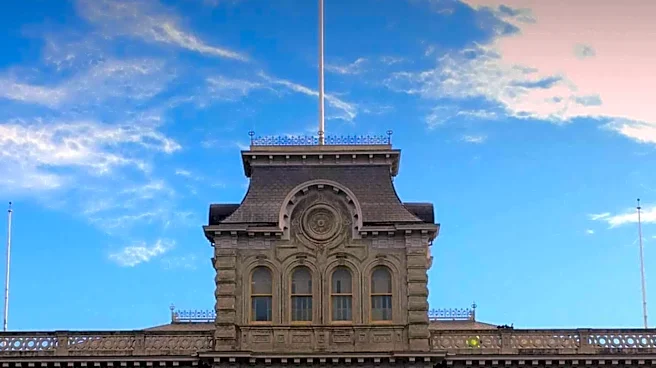
The Newlands Resolution was introduced in the House of Representatives as H.J.Res. 259 by Francis G. Newlands. It passed the House on June 15, 1898, with a vote of 209 to 91, and the Senate on July 6, 1898, with a vote of 42 to 21. President McKinley signed the resolution into law on July 7, 1898, officially annexing Hawaii as a U.S. territory. A formal ceremony was held on August 12, 1898, where the Hawaiian flag was lowered, and the U.S. flag was raised over Iolani Palace, symbolizing the transfer of sovereignty.
The resolution also established a five-member commission to study the laws needed in Hawaii. This commission included notable figures such as Territorial Governor Sanford B. Dole and former Hawaii Chief Justice Walter F. Frear. Their final report led to the creation of the Territory of Hawaii in 1900, providing a framework for governance under U.S. law.
Long-term Implications
The annexation of Hawaii had significant implications for the islands and their people. It facilitated duty-free trade between Hawaii and the mainland United States, boosting the local economy. However, it also raised concerns about the political and cultural impact on the native Hawaiian population. The establishment of an elected territorial government was met with objections, as it was feared that it could lead to the admission of a state with a non-white majority, a contentious issue at the time.
The Newlands Resolution set Hawaii on a path toward statehood, which was achieved in 1959. While it brought economic benefits and strategic advantages to the United States, it also marked the beginning of a complex relationship between Hawaii and the mainland, with lasting effects on the islands' cultural and political landscape.