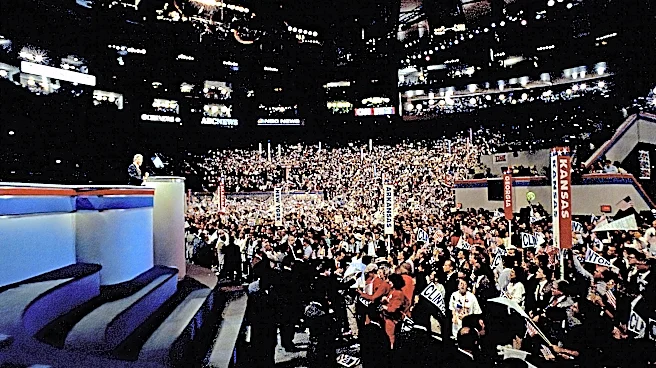



The 1996 United States presidential election, held on November 5, 1996, saw the successful reelection of incumbent Democratic President Bill Clinton. This election was a significant event in American politics, pitting Clinton against Republican nominee Bob Dole, a former Senator from Kansas, and independent candidate Ross Perot, a businessman representing the Reform Party. The outcome solidified Clinton's presidency for a second term, marked by a substantial
popular vote margin and a decisive victory in the Electoral College. The election also highlighted the continuing, albeit diminished, influence of third-party candidates in the American political landscape.
The Contenders and Their Campaigns
President Bill Clinton, as the incumbent, ran for reelection with Vice President Al Gore as his running mate. Clinton's campaign benefited from a period of economic recovery following the early 1990s recession and a relatively stable international environment. His platform and performance during his first term resonated with a significant portion of the electorate, leading to his strong showing.
On the Republican side, Bob Dole, a long-serving Senator from Kansas, secured his party's nomination after defeating several other candidates, including Pat Buchanan, in the primaries. Dole chose Jack Kemp as his running mate. Despite his extensive political career, Dole faced an uphill battle against an incumbent president who was enjoying favorable economic conditions and a generally positive public perception.
The Third-Party Factor: Ross Perot's Role
Ross Perot, who had made a notable impact in the 1992 presidential election as an independent candidate, returned in 1996 as the nominee for the newly founded Reform Party. His running mate was Pat Choate. While Perot still garnered a significant number of votes for a third-party candidate by U.S. standards, his performance in 1996 did not replicate his earlier success. He received less media attention and was notably excluded from the presidential debates, factors that likely contributed to his reduced visibility and impact compared to 1992.
Perot's campaign, despite its diminished profile, still managed to secure 8.4% of the popular vote, totaling 8,085,294 votes. This performance, while strong for a third party, was considerably lower than his 1992 results. His presence in the race meant that neither Clinton nor Dole achieved a majority of the popular vote, with Clinton narrowly missing it despite his substantial electoral victory.
Election Results and Electoral College Dynamics
On election day, Bill Clinton secured a clear victory with 379 electoral votes, significantly surpassing the 270 votes needed to win. Bob Dole received 159 electoral votes. Ross Perot, despite his popular vote share, did not win any electoral votes. Clinton carried 31 states plus the District of Columbia, while Dole won 19 states.
In terms of the popular vote, Clinton received 47,401,185 votes, or 49.2% of the total. Dole garnered 39,197,469 votes, accounting for 40.7%. The turnout for the election was 49.0%, representing a decrease of 6.2 percentage points from the previous election. This outcome demonstrated a strong mandate for Clinton's second term, built on a recovering economy and a stable global outlook, even as the third-party presence continued to shape the overall vote distribution.