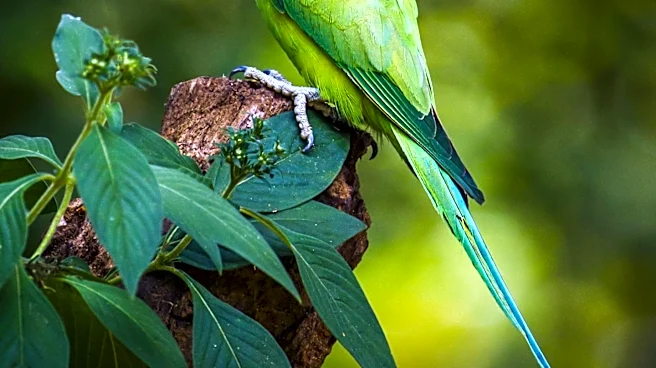










The rose-ringed parakeet, known scientifically as *Psittacula krameri*, is a medium-sized parrot with a fascinating history of global distribution. Originally native to specific regions in Africa and the Indian subcontinent, this species has expanded its presence across numerous countries, largely due to human activity. Its journey from its natural habitats to becoming a common sight in cities worldwide highlights its adaptability and the long-standing
human interaction with this distinctive bird.
Ancient Origins and Native Habitats
The rose-ringed parakeet's native range is disjunct, meaning it occurs in two separate geographical areas. In Africa, it can be found in a narrow belt stretching across the continent, roughly between 4° to 17° North latitude, coinciding with the Sudanian savannas. In Asia, its native territory spans the Indian subcontinent and Sri Lanka, from 6° to 35° North latitude, extending from the foothills of the Himalayas and the Indus River valley in Pakistan eastward to the Irrawaddy River valley in Myanmar.
This widespread native distribution suggests a species well-adapted to diverse tropical environments. The parakeet's presence in these regions has been documented for centuries, with ancient civilizations recognizing and even keeping these birds. For instance, the ancient Greeks kept the Indian subspecies, *P. krameri manillensis*, while the ancient Romans favored the African subspecies, *P. krameri krameri*, indicating a long history of aviculture and human appreciation for these parrots.
The Rise of Feral Populations
Since the late 20th century, the rose-ringed parakeet has successfully colonized many other countries far beyond its native range. This expansion is primarily attributed to escapes from captivity and deliberate releases, often stemming from the exotic pet trade. Once established, these introduced populations have thrived, demonstrating the species' remarkable ability to adapt to new environments.
Today, the rose-ringed parakeet breeds further north than any other parrot species globally. Significant feral populations have established themselves on a large scale in European countries such as Germany, France, Belgium, the Netherlands, Italy, and the United Kingdom. This widespread establishment of non-native populations has led to the species being listed as "least concern" by the International Union for Conservation of Nature (IUCN), as its overall population appears to be increasing, despite localized reductions in its native range due to its popularity as a pet and conflicts with farmers.
Factors Contributing to Global Success
The success of rose-ringed parakeets in establishing feral populations in new regions can be linked to several factors. Their adaptability to various food sources, including buds, nectar, fruits, vegetables, nuts, seeds, and grains, allows them to exploit resources in urban and suburban landscapes. They are also known to visit gardens and bird feeders near human habitation, further aiding their survival in populated areas.
Furthermore, researchers suggest that decreasing frost days due to global warming, rising urbanization, and increasing human populations may contribute to the continued expansion of parakeet establishments. The significant separate parakeet imports into Europe have also allowed researchers to investigate the hypothesis of climate matching and human activity at the species level, providing insights into how these birds successfully colonize new territories. The species' ability to reproduce in winter, avoiding competition for nest sites and utilizing winter pea crops for egg production, also contributes to its reproductive success in diverse climates.
Interactions in New Environments
While their global spread is a testament to their resilience, the presence of feral rose-ringed parakeets in non-native areas can lead to complex ecological interactions. For example, in the María Luisa Park in Seville, Spain, a significant increase in the parakeet population coincided with a sharp decline in the greater noctule bat population. The parakeets aggressively attacked the bats at tree cavities, occupying most of the sites previously used by the bats, often leading to the bats' death. This resulted in an 81% decrease in tree cavities occupied by the greater noctule over 14 years, with bats actively avoiding areas near parakeets.
Similar aggressive behaviors have been reported in other regions, including lethal attacks on Leisler's bats in Italy and black rats in Spain, as well as an attack on a red squirrel in the Paris area of France. These observations highlight the potential ecological impact of introduced rose-ringed parakeet populations on local wildlife, underscoring the multifaceted consequences of their global journey.