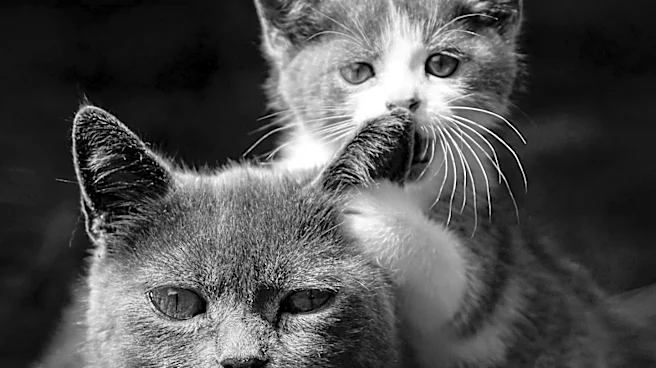








While often perceived as solitary creatures, cats, both domestic and wild, engage in complex social behaviors. Their social structures range from free-living colonies to intricate interactions within multi-cat households and deep bonds with humans. Understanding these social dynamics, including how they learn and communicate, is key to appreciating the nuanced lives of felines and fostering positive relationships with them. Domestication has significantly
altered some aspects of cat communication, particularly in their interactions with people.
Colony Organization and Social Learning
Free-living domestic cats frequently form colonies, which can be small, consisting of a queen and her kittens, or larger, involving several queens and their offspring. Male cats are present in both types, contributing to reproduction and territorial defense. Within these colonies, reciprocal altruism can occur, where a queen who helps another giving birth will receive similar aid when her time comes. These colonies often form for protection against predators and access to food, though stable social orders, like those seen in lions, are not typically present. Group living offers advantages such as easier access to mates and defensive measures for food, but also presents challenges like sexual competition and potential fights over resources if the group becomes too large.Cats are observational learners, a trait that emerges early in life. Kittens learn hunting techniques by observing their mothers. The mother cat gradually introduces dead prey, then live prey, to teach her kittens how to capture it successfully. This observational learning improves prey-catching behavior over time. The process can be described by a drive (hunger), a cue (prey), a response (catching prey), and a reward (relieving hunger). This learning extends to human interactions; kittens are more likely to socialize with humans if their mothers exhibit non-aggressive behavior. Even adult cats demonstrate observational learning, performing tasks faster if they've seen another cat do it.
Socialization Between Cats: Dominance and Conflict
When unfamiliar cats meet, an ideal scenario involves them cautiously sniffing each other's hindquarters, though this is rare. More often, a sudden movement by one cat can trigger a defensive response in the other, leading to a subordinate cat preparing to attack. If a fight ensues, the subordinate cat usually flees, but sometimes a "tomcat duel" can occur. Dominance plays a role in interactions within multi-cat households, with subordinate cats exhibiting behaviors like avoiding eye contact, crouching, or retreating from a dominant cat. The dominant cat, in turn, may display an upright posture with ears straight up and an arched tail base, looking directly at the subordinate.While dominant cats are generally not aggressive, they may become so if a subordinate cat blocks access to food. This aggression can lead to dominant cats preventing subordinates from eating or using the litter box, potentially causing elimination problems and affecting human interaction. Social conflicts among cats are often triggered by the protection of food, litters, or territory. A tomcat duel typically begins with both cats drawing themselves up, hair bristling, and vocalizing loudly as they approach. The confrontation escalates to biting and aggressive rolling, with intense screams. These fights can continue until one cat is defeated and retreats after the victor has surveyed the area.