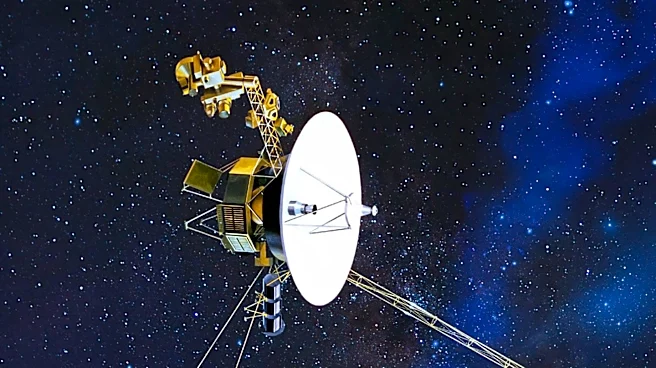

Voyager 1, launched in 1977, represents an extraordinary feat of human engineering and perseverance. As the farthest human-made object from Earth, its mission has extended far beyond its initial planetary
flybys, venturing into the vastness of interstellar space. This enduring journey has been sustained by robust design and innovative management, allowing the probe to continue transmitting scientific data decades after its launch. However, operating a spacecraft at such extreme distances comes with unique challenges, particularly concerning its power supply, communication capabilities, and the maintenance of its critical orientation systems.
Managing Power and Operational Lifespan
The longevity of Voyager 1's mission is fundamentally tied to its power source: three radioisotope thermoelectric generators (RTGs). These RTGs, which contain plutonium-238 PuO2 oxide spheres, generated approximately 470 watts of electric power at launch. Unlike solar-powered spacecraft, RTGs provide a continuous power supply, essential for deep space missions where sunlight is too weak to be effective. However, the power output of these generators naturally declines over time due to the radioactive decay of the fuel and the degradation of the thermocouples.
Despite this gradual decrease, current plans project that the RTGs may continue to supply enough electric power to return engineering data until 2036, and potentially keep at least one science instrument operational into the 2030s. As of 2026, only two instruments, the Plasma Wave Subsystem and the magnetometer, remain operational, a testament to careful power management and the prioritization of key scientific objectives. This extended lifespan, far exceeding original expectations, allows for continued exploration of the interstellar medium.
Overcoming Communication and Orientation Hurdles
Communication with Voyager 1 is a complex endeavor, given the immense distances involved. The probe communicates through NASA's Deep Space Network (DSN) using a 3.7-meter (12 ft) diameter high-gain Cassegrain antenna. As of 2025, signals from Voyager 1 take more than 23 hours to reach Earth, highlighting the significant time delay in command and data transmission. The spacecraft transmits data at frequencies of 2.3 GHz or 8.4 GHz, while receiving commands from Earth at 2.1 GHz.
Maintaining the correct orientation of the spacecraft is paramount for effective communication, as its high-gain antenna must remain precisely pointed towards Earth. This task falls to the Attitude and Articulation Control Subsystem (AACS), which uses 16 hydrazine thrusters, three-axis stabilization gyroscopes, and referencing instruments. A significant concern arose with the orientation thrusters, but in 2017, the Voyager team successfully fired the trajectory correction maneuver (TCM) thrusters for the first time since 1980. This critical maneuver extended the mission by two to three years. Further successful revivals of several thrusters in 2018, 2019, and 2025 demonstrate ongoing efforts to manage and extend the operational life of this pioneering spacecraft, ensuring its continued ability to send back invaluable data from the edge of our solar system and beyond.