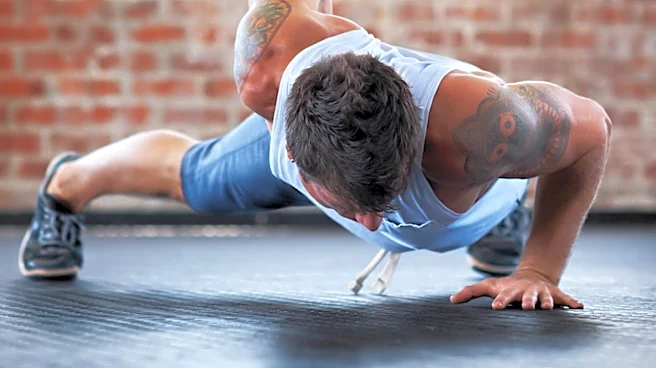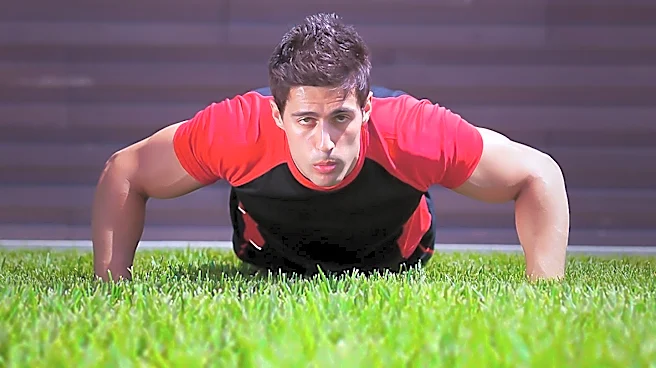






The push-up, known as a press-up in British English, stands as a fundamental calisthenics exercise performed from a prone position. This exercise involves raising and lowering the body using the arms, with the legs serving as support. It primarily targets the pectoral muscles, triceps, and anterior deltoids, while also offering ancillary benefits to other deltoid muscles, the serratus anterior, coracobrachialis, and the entire midsection. Widely used
in civilian athletic training, physical education, and military physical training, the push-up is also a common form of punishment in military, school sports, and some martial arts disciplines due to its humiliating factor when a specified amount is not met, and its lack of equipment requirement.
Muscular Engagement and Biomechanics
The push-up is a complex exercise that engages numerous muscle groups throughout the body. The primary muscles worked include the pectoralis major and minor, which are the large chest muscles responsible for most of the pushing action during the exercise. The anterior portion of the deltoid muscle, a major shoulder-joint horizontal adductor, moves the upper arms toward the chest during the upward phase and helps control the speed of movement during the downward phase. The deltoid attaches to parts of the clavicle and scapula, just above the shoulder joint, and to the outside of the humerus bone. Beyond horizontal adduction, the anterior deltoid also assists with flexion and internal rotation of the humerus within the shoulder socket.
Crucially, the triceps brachii muscles, or triceps, are heavily involved in extending the elbow joints to fully extend the arms during the upward phase. They also control the speed of elbow-joint flexion during the downward movement. The closer the hands are placed during a push-up, the more intensely the triceps are worked. This muscle is divided into three heads: the lateral, long, and medial heads. The lateral and medial heads attach to the back of the humerus bone, while the long head attaches just behind the shoulder socket. All three heads combine to attach to the back of the elbow.
Stabilizer Muscles and Core Strength
Beyond the primary movers, stabilizer muscles play a vital role in maintaining proper form and executing the push-up effectively. The erector spinae, comprising the spinal, longissimus, and iliocostalis muscles, serves as the main stabilizer in the back. The spinal runs adjacent to the spine, the longissimus runs alongside the spinal, and the iliocostalis runs adjacent to the longissimus and over the ribs. Additionally, the gluteus medius and gluteus minimus, located beneath the gluteus maximus, work to stabilize the upper leg. The rectus abdominis and transversus abdominis contract continuously to hold the body off the floor and keep the legs and torso aligned. The rectus abdominis, the most prominent abdominal muscle, spans the front of the abdomen, while the transversus abdominis lies deep within, wrapping around the entire abdominal area. Both compress the abdomen, though the rectus abdominis does not flex the spine forward during a push-up.
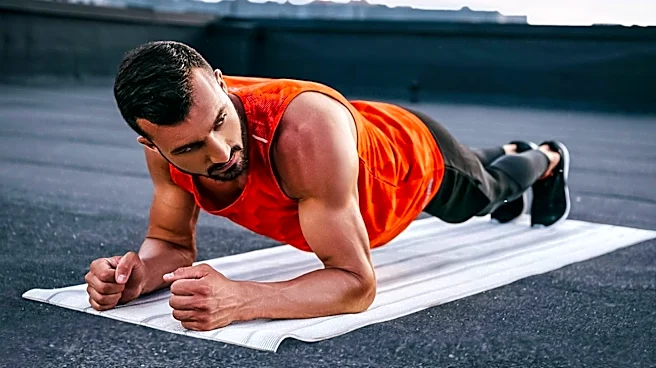
Inner muscles supporting the fingers, wrists, forearms, and elbows are also worked isometrically. Some push-up modifications that require arms at different heights effectively engage the rotator cuff. The short head of the biceps brachii muscle acts as a dynamic stabilizer, activating at both the elbow and shoulder to help stabilize the joints. Stabilizers also include wrist and forearm muscles, knee extensors, and hip/spine flexors, all working isometrically to maintain a proper plank position in the standard prone push-up.
Variations and Their Benefits
The push-up offers a wide array of variations, each designed to target specific muscle groups or increase the challenge. The "full push-up" maintains a straight back and legs off the floor. Variations like the