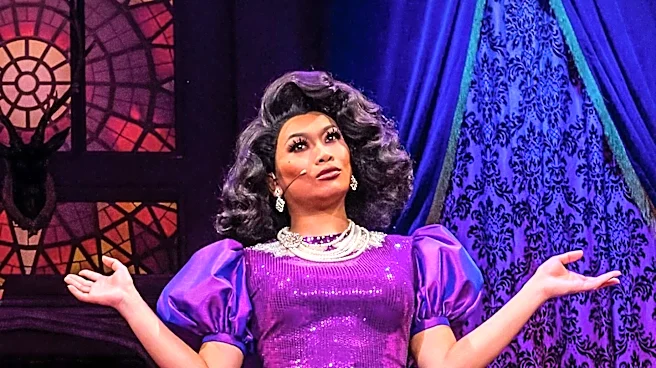








The journey of *La Cage aux Folles* from a French farce to a celebrated Broadway musical is a testament to creative adaptation and perseverance. What began as a 1973 French play by Jean Poiret, centering on the comedic confusion arising from a gay couple's son introducing his ultraconservative in-laws, eventually transformed into a groundbreaking musical. This transformation involved a series of creative shifts, changes in personnel, and a deliberate
effort to craft a production that would resonate with a broad audience while still conveying its core message.
Early Attempts and Creative Shifts
Initially, Allan Carr, known for producing the successful film adaptation of *Grease*, sought to bring a musical version of the popular *La Cage aux Folles* film to Broadway. However, he was unable to secure the film rights and instead obtained the rights to the theatrical script. Carr's initial team included Jay Presson Allen for the book and Maury Yeston for the score, envisioning an Americanized version titled *The Queen of Basin Street*, set in New Orleans. Mike Nichols was slated to direct and Tommy Tune as choreographer. This early iteration, however, was short-lived. Executive producers Fritz Holt and Barry Brown, brought on by Carr, promptly dismissed the entire creative team. While lawsuits followed, only Yeston successfully won, receiving a small royalty from the eventual *La Cage* musical.
Holt and Brown, who had previously produced the 1974 revival of *Gypsy*, approached Arthur Laurents to direct their new venture. Laurents, initially skeptical due to the prevailing homophobia during the early years of the AIDS epidemic, believed investors would be hard to find for a gay-themed project. His interest was piqued, however, when Harvey Fierstein and Jerry Herman joined the project. This new creative trio would ultimately shape the musical into the form that found immense success on Broadway.
Crafting the Broadway Musical
The collaboration between Fierstein, Herman, and Laurents was pivotal. According to Laurents, when they first met, the title and original setting had been restored, but no draft of the plot existed. Herman had already composed the song "I Am What I Am," which Laurents immediately recognized as the perfect closing number for the first act. Laurents claimed his ideas inspired the direction of the musical, though Herman offered a different account. Herman recalled Fierstein arriving one day with a powerful scene for the end of Act One, which included the line "I am what I am." Herman, delighted, asked to use the phrase, promising a song by the next day, a promise he fulfilled.
With the gay activist Fierstein and the politically minded Laurents involved, the show could have become a controversial statement on gay rights. However, Herman acted as a moderating influence. Having experienced disappointments with darker-themed shows since 1969, he aimed for a successful, emotionally entertaining production with optimistic songs and dances that would appeal to a middle-class audience. The team decided to create "a charming, colorful musical comedy; an old-fashioned piece of entertainment," as Herman described in his memoirs. By presenting their sentiments in an "entertainingly sweet form," they believed their gay-themed message would have a greater impact than a more aggressive approach.
Refining the Narrative and Characters
Fierstein, Herman, and Laurents met daily at Herman's Manhattan apartment to develop the musical. Limited to Poiret's original script as their source, they could not include Jean-Michel's mother, a character created for the film. Instead, they focused the plot on the idea that Georges and Albin's relationship was so natural that their son could accept a man as his "mother." They also agreed that Albin needed to be as glamorous as possible, leading to the hiring of Theoni V. Aldredge as costume designer to achieve this goal.
During previews in Boston, Herman experienced a panic attack, fearing the city might be too conservative for a gay-themed musical, even one intended for a general audience. However, the Boston audience's enthusiastic reception proved his fears unfounded. The creators realized the show was fundamentally a love story where the lovers barely touched. Fierstein suggested a kiss on the cheek at the end, and Laurents, referencing the French custom of men kissing on the cheeks, agreed. George Hearn, cast as Albin, delivered powerful musical numbers, portraying a complete character whose drag persona revealed "a person driven to make a decision for himself – an idea with which everyone identifies." While Gene Barry, playing Georges, was considered adequate but not outstanding, Laurents' last-minute direction for Barry to maintain eye contact with Hearn during their shared scenes helped convey the depth of their feelings, enhancing the audience's understanding of their profound connection.