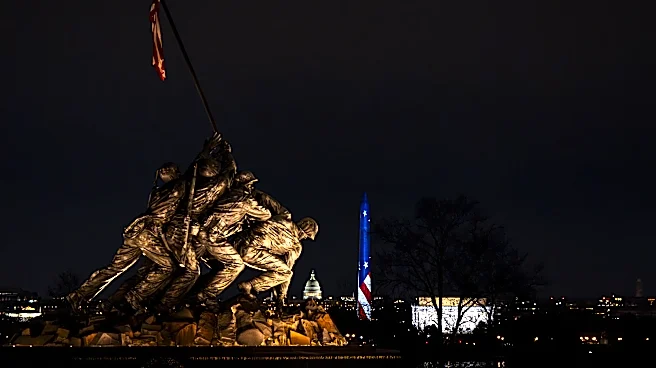



The Marine Corps War Memorial, a prominent landmark in Arlington, Virginia, immortalizes one of the most iconic moments in American military history: the second flag-raising on Mount Suribachi during the Battle of Iwo Jima. This powerful sculpture captures the raw emotion and collective effort of six Marines, transforming a fleeting moment of wartime into an enduring symbol of courage and sacrifice. The memorial's detailed depiction and its historical
context offer a profound insight into the significance of this event for the U.S. Marine Corps and the nation.
The original event unfolded on February 23, 1945, atop Mount Suribachi, a strategic location on Iwo Jima. Initially, a smaller U.S. flag was raised, but it was soon deemed insufficient, as it was not visible to all American troops engaged in the intense fighting on the other side of the mountain. This led to the decision to replace it with a larger flag. The moment of this second flag-raising was famously captured in a photograph by Joe Rosenthal, an image that quickly became a powerful symbol of the war effort. Crucially, Marine Sergeant Bill Genaust, a combat motion picture cameraman, also filmed the event in color while standing beside Rosenthal, providing irrefutable evidence that the flag-raising was not staged.
From Battlefield to Bronze: Felix de Weldon's Vision
The profound impact of Rosenthal's photograph inspired the creation of the Marine Corps War Memorial. In 1951, the United States Congress approved the memorial, and the Marine Corps League selected Felix de Weldon as the sculptor. De Weldon's task was immense: to translate the dynamic energy of the photograph into a colossal, three-dimensional bronze sculpture. He dedicated three years to crafting a full-sized master model in plaster, ensuring that the figures, each standing 32 feet tall, conveyed the heroism and struggle of the original moment.
The intricate process involved disassembling the plaster model into 108 individual pieces. These pieces were then transported to the Bedi-Rassy Art Foundry in Brooklyn, New York, where they were sand-cast in bronze. This casting process alone took nearly three and a half years, a testament to the scale and complexity of the project. Once cast, the bronze sections were reassembled into a dozen larger pieces and carefully shipped back to Arlington, Virginia, in a three-truck convoy. This meticulous attention to detail ensured that the final monument would be a faithful and powerful representation of the historic event.
The Memorial's Enduring Presence and Symbolism
Installation of the memorial began in September 1954, culminating in its dedication on November 10, 1954, the 179th anniversary of the Marine Corps' founding. The monument's base, made of black diabase granite from Sweden, features several inscriptions that further honor the Marine Corps. The total cost of $850,000 was entirely covered by donations from active duty Marines, reservists, former Marines, and friends of the Corps, highlighting the deep personal connection many had to the memorial's purpose. No public funds were used, emphasizing the community-driven nature of its creation.
Today, the Marine Corps War Memorial stands on a high ridge overlooking the national capital, serving as a constant reminder of sacrifice and valor. President John F. Kennedy's 1961 proclamation ensures that a U.S. flag flies over the memorial 24 hours a day, a rare honor. While the sculpture depicts an event from when the U.S. flag had 48 stars, a modern flag is always flown, symbolizing the memorial's dedication to all Marines who have died in defense of the United States, regardless of when their deaths occurred. This detail reinforces the memorial's timeless message and its commitment to honoring every Marine who has served.